On Grief

I looked down at the bottom of the Zoom screen. Participants-78. I felt somewhat relieved that with a gathering of this size, I could remain somewhat invisible. The workshop was titled, “The Mystery of Grief, Writing into the Loss,” led by a favorite poet, Rosemerry Wahtola Trommer.

Rosemerry began by singing the beautiful words of Gregory Orr, a selection from a longer work:

Not to make loss beautiful,
But to make loss the place
Where beauty starts. Where
the heart understands
For the first time
The nature of its journey.

She talked about her own experience and how writing helped her to meet her grief in whatever form it presented itself. It’s everchanging, day by day. “Grief – what do you have to teach me today?” she asks. Rosemerry meets her grief with a daily poem writing process. She begins with this curiosity and writes, “Today grief is….”

As a group, we added our own responses to the prompt in the Chat. The responses were powerful and heartfelt. Some I captured in my notebook.

Today grief is…
tender
a vibration
bone-weary
a tumultuous river
a frozen river
underground
right behind my eyes
an endless knot
muscular
a freefall
beside me

Having lost a dear friend on Tuesday, March 6, my tears were close, but I felt comfort in this group of strangers coming together around loss. We had all experienced it, as every human being must. There was compassion for the experience of being in the grocery store and wanting to shout at strangers, “Can’t you see how sad I am?” Compassion for the woman who is the caregiver for her husband and his cancer after losing a daughter to cancer six months ago. Compassion for the impossibility of understanding suicide. Compassion for the new widow trying to figure out how to be in their shared home of 50 years without his presence.

Rosemerry encouraged us to pay attention and reflect on what happens in our bodies when we write. How does writing open us to know when we are writing what is true?

Isn’t it remarkable what we can carry at times and how we are also carried? Isn’t it a wonder how resilient and adaptive humans can become? Isn’t it a blessing when we gather with others (even strangers) and know we are not alone? How differently we might treat others if we only knew the things they hold in their hearts.

Please go here to read another poem we discussed called, “Made Visible” by poet, James Crews. It just might touch you.
Thank you to all who make this writing space
a place of safety, support, and beauty.
Mark Making

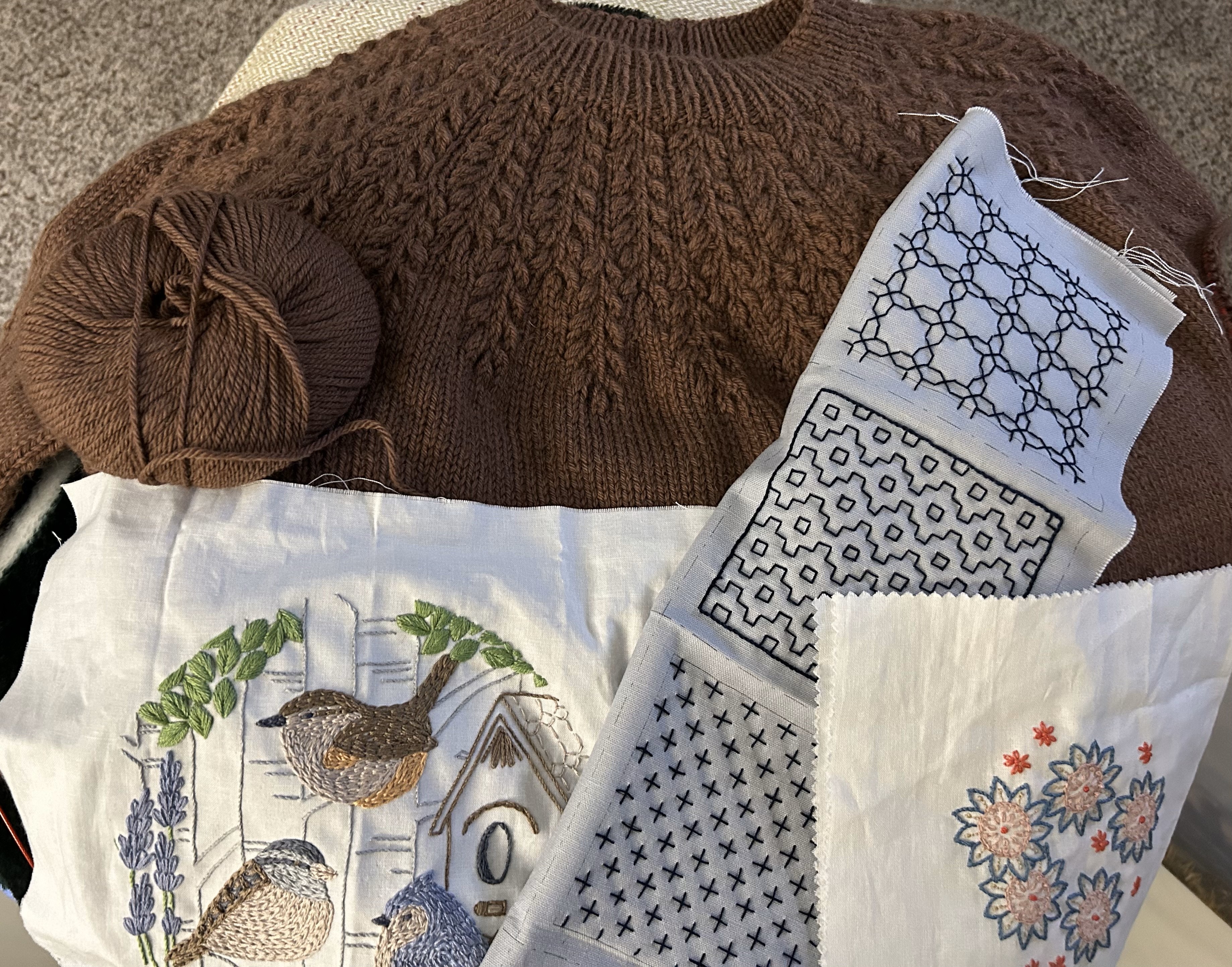
The phrase, “making your mark” has shifted in meaning for me. I used to think that you made your mark when others noticed you, or when you got recognition for your work. I guess external affirmation is what “making your mark” meant to me. We often speak of historical figures having made a mark by effecting change, or musicians and artists who made their mark by creating new forms of expression.

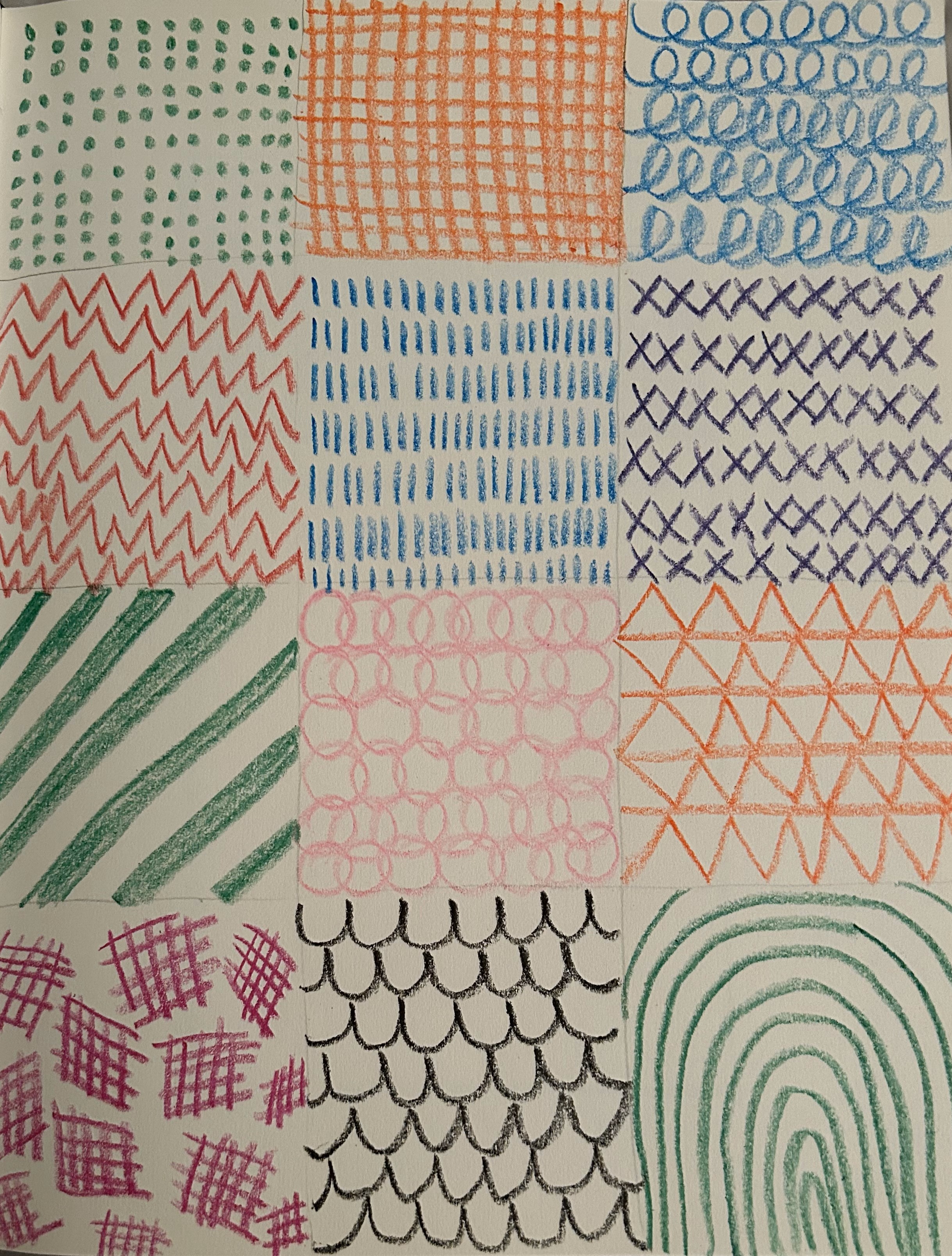
Now, in this moment, I feel that “making my mark” is simply making the marks. It’s the creative impulse to sew a stitch, use a colored pencil, write a few words, or play a few notes. The mark making is enough because of the internal change I feel–the internal affirmation that it feels good to put marks on a page. It feels good to play the piano. It feels good to write. That’s enough for me.

2024 knitting and stitching
My page from: “Developing Your Visual Vocabulary: A Daily Practice in Mark Making” Class by Lisa Congdon
Thank you to all who make this writing space
a place of safety, support, and beauty.
That Season

Photo courtesy of Unsplash

The love of baseball seems to run in families. Mine was one of them as my brother was quite a skilled player–catcher, hitter, 3rd baseman. My two sons played as they were growing up and now one of my sons is coaching 3 teams–a Little League Majors team, a travel club team, and assisting with a Little League AA team. That’s a lot of baseball.

I decided to walk a different path today at the local middle school. It was dusk and I figured I had just enough time before the sun set to get in a good walk. I noticed that there was a young baseball team having practice. As I walked I could hear the chatter of 10-year old boys joshing and hollering, laughing and living their best life. It made my heart so happy.

As I approached the backstop area, it was getting dark. A few parents had gathered to pick up their sons. The coach had the boys facing each other in two lines. On his command, one line started chucking 10-inch nerf balls at the other side. The coach called the outs. (If you got hit, you were out.) I’m not sure if there was any scorekeeping, but the boys were all in. I wondered if this was a team-building exercise, or a throwing exercise, but it really didn’t matter.

Kids outside together. Playing until the street lights came on. Building memories. That’s what mattered.

Thank you to all who make this writing space
a place of safety, support, and beauty.

Naming the Concept

I was listening to a podcast (yes, I do that quite frequently!) and had my mind blown by a concept called “the second simplicity.” The idea is that we often start with a certain simplicity, then enter a state of complexity, and come out the other side with a second simplicity that is deeper and richer than where we began. This is a natural progression, but somehow having a name for it is very cool.

An example was offered of a fifth grader playing Beethoven’s “Fur Elise.” The student has learned the notes, the rhythm, and perhaps something about the form of the piece. Later, that piano student goes deeper into the complexity of music including the life of Beethoven, his style and contributions to the Romantic period. Perhaps more study would include harmony, structure, dynamics, phrasing, and personal expression. After deep study, the pianist returns to “Fur Elise” with a deeper appreciation of its beauty and is able to add wisdom to the performance. Same notes played, but how the music is enriched.

I googled this concept and learned that Oliver Wendell Holmes put it this way:

“I would not give a fig for the simplicity this side of complexity, but I would give my life for the simplicity on the other side of complexity.”

All day, I was thinking about this as I cooked, cleaned, and tended to Saturday chores. I think the second simplicity certainly applies to motherhood (with grandmothering being the 2nd simplicity). I think it applies to teaching reading and writing, too. It’s another way of looking at anything we might struggle with or strive toward. Working through the complexity of the “messy middle” is usually rewarded with a profound sense of peace when there is an end to the striving. I love that now I have a name for that feeling–the second simplicity.

What do you think?

Thank you to all who make this writing space

a place of safety, support, and beauty.

From Fear to Form

In recent years, I have enjoyed exploring poetry. Through the magic of Zoom, I have learned about so many current poets and their poems. Reading poems has led to writing prompts and my own attempts at writing poems. I get a lot of pleasure in playing with words and forms.

One form, however, has intimidated me and I told myself a story that I couldn’t write a pantoum. Until today. I’m taking a 6-class series called “Poetry is Life” taught by Ann Quinn through Yellow Arrow Publishing in Maryland. We usually study three poems each session and practice writing from them. The form we visited today was, for me, the dreaded pantoum. It seemed impossible to think of a topic that could become a pantoum. I didn’t know where to start. I even considered not trying.

Carefully, Ann walked us through Natasha Trethewey’s poem, “Incident” and essentially mapped the lines into a code I could follow as I wrote my own poem. I also learned that pantoums often reveal a narrative with layers of meaning.

Here’s my first pantoum:

Fine

He says he’s fine
after blood drenched his tie
I’m good, he says
bright red spots down his white shirt.

After blood drenched his tie
a friend stopped to help
bright red spots down his white shirt
It will be okay.

A friend stopped to help
He didn’t have to
It will be okay
but she’s not sure she believes

He didn’t have to
speak soothing words and take slow steps
but she’s not sure she believes
and kindness sometimes lies

Speak soothing words and take slow steps
I’m good, he says
and kindness sometimes lies
He says he’s fine.

Isn’t it so interesting that we can change the stories we tell ourselves? Today, I’m happy that some of my fears of new forms were set aside. I learned that a pantoum is actually a fun word puzzle. I am grateful to have teachers and other poets to guide me.

Thank you to all who make this writing space

a place of safety, support, and beauty.

Outside

I listened to an episode of the #1000hoursoutside podcast yesterday. Alistair Humphreys was interviewed about his new book called Local: A Search for Nearby Nature and Wildness. In this book, he describes a year-long project to get to know the topography, the plants and animals, the geology, and the community where he lives in England. He spoke about having a “sit spot,” a place to sit on a log and just observe for an hour. No notebook, no phone, no agenda. Just watching and listening. I’m looking forward to reading this book and perhaps applying some of the experiences he talked about to my own life.

I recognize, more clearly than ever before, the benefits of getting outside. Even feeling the sun on my face for the minute it takes me to walk to my car after school has brought a renewed gratitude for something too often taken for granted. This afternoon, I walked under heavy cloud cover even though rain was imminent. The gray clouds seemed to intensify the quiet along the path. I could hear the ripples of water from the stream down the hill. As a cardinal flew out of the thicket, there was no sound, but the red flash caught my eye. The breeze on my face helped clear my mind of the clutter of the week.

As I begin this month of daily Slice of Life writing, I’ll be writing local. Right here.

Thank you to all who make this writing space

a place of safety, support, and beauty.

Games People Play

I’m participating in Laura Shovan’s 12th Annual February Poetry Project. Each year participants create a poem each day in February and the month has a theme. One year, the theme was our bodies; this year, the theme is Games. I wasn’t sure I was going to enjoy this theme (I think I identify with work more than play, although this is changing as I grow older.)

Here is a poem I wrote using the names of game shows:

Marriage

To Tell the Truth
You could Press Your Luck,
Spin the Wheel of Fortune,
Even focus with deep Concentration
And never be able to
Name That Tune,
Answer The $64,000 Question
Or resolve a Family Feud.
You might
Wipeout on
The Gong Show,
Or put yourself in Jeopardy
But that won’t tell you whether to
Win, Lose, or Draw.
Whose Line is it Anyway?
Just to know if the Price is Right|
Or the secret Password
Won’t help in The Newlywed Game
Or this 48-year Match Game.
Deal or No Deal?

More and more, I’m learning to trust that if I just start, just put pen to paper, something will come. It feels good.

Outside

Over the past year I have been trying to gather and write stories from my childhood. I found that the more I remembered, the more I realized that most of my significant memories are of being outside. I’m so grateful to have grown up in a time when play was mostly unsupervised. It was unhurried time. There was plenty of time to explore at the creek or in the woods or to swing on the swingset.

I wrote last week (here) about my grandson falling into the creek. Let me say a little more about that. Three of my grandchildren were walking with me down to the neighborhood park that has a stream flowing through it (Bear Branch Stream which feeds into larger tributaries of the Potomac River). It’s a short walk from my house, but I always feel transported to another time when we reach the park.

It had rained a lot the day before and the ground was muddy, but the sun was out so we went. Maggie asked if she and Johnny could run across the bridge. I knew the stroller wouldn’t go well in the mud, so I said they could go. I stayed with Molly at the swings. It made me so happy to watch them tear off across the bridge and down the path on the other side of the creek. It’s a good path that I know well. I could see Maggie’s long hair flowing behind her as she ran through the trees. Her pink coat made it easy to see where they were.

Molly is at the age where she would be happy to be pushed in a swing for hours. I pushed and pushed. I had my back turned away from the creek for just a few moments. Then I heard, “Grandmaaaaaaa! Johnny’s fell in the creek!” As they ran back from the woods, Johnny had taken a wide turn and slipped off the footbridge. By the time I saw them, he had climbed up the bank and looked afraid that he might be in trouble. He stood still and said nothing. I laughed and assured him he was fine. It was just an “Oops!” I was actually happy for him to have the experience of freedom, even freedom to fall with no harm done.

I guess that’s my wish for all children–to be able to play outside, to experience the natural world, to fall and get up, to get wet sometimes and not be afraid. To look up and notice the bare branches against a winter sky. To smell pine and feel rejuvenated. To hear the Carolina Wren’s sweet song and the chirp of a cardinal. Perhaps then, they will believe that the world is more good than bad.

Laughter

When my daughter asked if I would watch her children so she and her husband could celebrate 10 years of marriage, I said, “Of course!” But first, I had to take a moment to process that my youngest child has been married for 10 years! I honestly don’t know how time has passed so fast.

My time with her three children was spent playing games, watching a movie, building rooms with blocks to house the collection of animals, and providing lots of snacks. In the afternoon, we took a walk which ended with one slipping into the creek. Thankfully, the temperatures were mild and no one was hurt. Just wet and maybe a little embarrassed. We hurried home to a warm bath.

As I got J warm and dry, he smiled and looked up at me and said, “Grandma, you laugh easily.” I don’t think anyone had ever voiced that observation about me, but it felt very nice coming from the mouth of my shy, almost 6-year old grandson. It must have felt important for him to say.

As Charlie Chaplin is often quoted, “A day without laughter is a day wasted.”

Probability

I have just finished reading THE PROBABILITY OF EVERYTHING by Sarah Everett. It’s a hard book to discuss without spoiling it for others. But as my friend, Sally, said, “Read it and then we’ll talk!” It may be one of the most powerfully written books I’ve ever read. It centers around a young girl’s relationship with her father. Having had a very close relationship with my dad, I felt a deep connection to this character. From dancing in the kitchen standing on my father’s feet, to gazing at stars together, to concerns about his failing health in later years, I felt like I knew exactly what Kemi felt. This connection is one reason I read–to feel part of the universe of humanity in ways that matter. Kemi loves science and specifically, probability.

In 1941, my father began his training with the FBI. He was fluent in German which was a strong asset at the beginning of World War II. The FBI trained him as a cryptanalyst, or codebreaker, and he was successful in using his knowledge of “codes and ciphers” to translate many intercepted communications into English. This was long before we had computers to assist investigators. The computer was his brain. From this period of his life, he developed a love for probability. While he had a rule that he would never place a bet for more than the cost of a meal, he did occasionally buy a lottery ticket for the fun of “what if the odds would favor me this time?” He spent hours around the kitchen table trying to teach me the basics of probability and strategies for simple code breaking. He may have been discouraged when I didn’t readily catch on or share his passion.

Fast forward to today. I realized that as a reading interventionist, I am like my dad. I think I’ve found the passion for code breaking through reading instruction. I’m teaching my students how to break the code by using patterns and probability with the 26 letters of the alphabet. Word play is a fun kind of exercise in probability. For example, playing Wordle more than 250 times, I had a 98% success rate. If your rate was 100%, I bow to you.

Young readers must become code breakers, too. I know this isn’t all they need, however; they also need a rich exposure to literature that touches their hearts, raises questions, and fosters curiosity. Just as code breaking served a higher purpose in my father’s work, I understand that decoding is not the end goal of reading. I fear that too many educators are forgetting this. In our current climate in elementary school, we are hyper-focused on phonics and related skills which will be meaningless if we don’t also help students WANT to read. Code breaking must serve the higher purpose of connecting us with ideas, wonder, and love for each other.

Read THE PROBABILITY OF EVERYTHING. Then, let’s talk.