Writing My Stories

When I was a Reading Teacher, I was always looking for ways to improve my instruction and engage students who had not yet discovered the “joys of reading.” Some were uninterested; others tried hard to mask their reading difficulties; others worked hard, but lacked background knowledge or life experiences which would contribute to enjoying books.

One winter, I came across a book by Kylene Beers and Robert E. Probst called NOTICE AND NOTE. They developed a system for teaching reading comprehension using 6 signposts that I found interesting and useful.  I started to test out these signposts in my own reading and decided this could work with my students. And indeed, it worked. Discussions grew deeper and questions more thoughtful as enjoyment of the book, HATCHET, by Gary Paulsen increased. 

Today, I’m no longer teaching reading, but instead, I’m working on writing the stories of my life. As I was walking in the neighborhood and doing a lot of reflecting about my life, my mind went to these signposts once again. I asked myself if the signposts could also be a scaffold for my writing. Would I be able as a writer to zoom out in order to recognize patterns and key understandings using the signposts? I’m interested to find out. 

These are the signposts outlined by Kylene Beers and Robert Probst:

Contrasts and Contradictions: When a character does or says something unexpected, you can stop and ask, “Why is the character doing that?”

Aha Moment:  When a character realizes, understands, or finally figures out something, you can stop and ask, “How might this change things?”

Tough Questions:  When a character struggles with hard questions, you can stop and ask, “What does this question make me wonder about?”

Words of the Wiser: When a character receives advice from someone older and wiser, you can stop and ask, “What is the life lesson and how might it affect the character?”

Again and Again: When a word, phrase, or situation comes up over and over, you can stop and ask, “Why does this keep happening again and again?”

Memory Moment: When the author interrupts the action with a memory from the character’s life, you can stop and ask, “Why might this memory be important?”

As I think about the story of my life, I’m sure there are threads that run through my experiences that could be identified by these signposts. Maybe there are other signposts yet to be named, but I think considering these markers might become useful to me as I write my stories and perhaps to those who read them.

I believe the work is largely the same for the writer and the reader. We are both striving to make meaning from the stories we live. The meaning of our stories can change over time as we grow and test our theories to find or reject what we think is true or not true. For it is truth we desire. Truth that tells who we were, who we are, and all we may become.

Emotional Experience at Rachmaninoff Festival

I know from the get-go that I won’t be able to adequately describe the experience I had on Saturday evening. My sisters, my niece, and I gathered to attend the Rachmaninoff Festival at the The Music Center at Strathmore in Bethesda, MD. I knew it was going to be an evening of huge emotion since all the music would be by Sergei Rachmaninoff, but I couldn’t have imagined the experience I was about to have. Three major works were performed by three different pianists with a relatively new symphony orchestra–The National Philharmonic. First, “Variations on a Theme of Paganini,” followed by the 2nd and 3rd Piano Concertos. All are much loved, enormous pieces of music, but again something fresh and new happened. An unexpected delight.

It was during the opening bars of the 2nd Piano Concerto that I knew I was about to hear something special. Each chord followed by a single low-bass note was alive and grew organically through those first few measures driving me deep into the sound. The pianist was previously unknown to me, but since Saturday, I have listened to many of his recordings. His name is Inon Barnatan. He was so skilled not only technically (Rachmaninoff is HARD to play!), but artistically so nuanced. For some musicians, performance becomes a showcase of ability, but his performance was so much more than ability–it felt more like a love-letter, a poem, or a familiar story.

The magic happened in the 2nd movement. Whenever the piano was paired with a single instrument such as the flute, oboe, or violin, Mr. Barnatan made eye contact with that member of the orchestra. He held that connection while we were privileged to listen as he played (without looking at the keys!) in conversation with the other musician. I’ve never witnessed anything so intimate, so beautiful, and so memorable as the feeling of oneness created through this performance. I imagined that the woman playing the flute especially had “a moment” perhaps unlike any other–the kind of moment which musicians and artists dream of creating. I know I had “a moment” which felt whole and pure, even spiritual, as tears freely rolled down my cheeks.

Afternoon Conversation

Visiting my daughter and her 3 children after school on Monday, 3/11/24. One is watching a video; one is playing with Mario Kart figures; one is planning a catfood business with her friend. My daughter is making her first baby sweater with a little coaching from me in the Magic Loop method. This might be a “you had to be there” moment, but I’ll share it here anyway.

Me (knitting): I love hanging out with you.

J (also knitting): I love hanging out with you, too.

Me: Yeah, we get each other.

J: Yup, we get each other.

9-year old granddaughter (with a bit of sass): I don’t get either one of you.

Cue: Laughter.

Thank you to all who make this writing space
a place of safety, support, and beauty.

40 Years

In the spring of 1984, I was a young mother with 3 young children–two boys and a girl. The women at my church had been taking turns making quilt blocks for each other. About 30 women were participating and when it was your turn to choose a pattern, you made 25-30 kits for stitching a block. At the end of the month, you would receive the 25-30 finished blocks which could then be sewn into a quilt top.

My turn came and my two sisters and I prepared kits for a quilt for my little girl. It was the 80s and “country” themes were popular. I chose the Sunbonnet Sue pattern. We had fun putting together fabrics so that no two Sunbonnet Sues would be exactly alike.

Also popular at that time was a sewing method called Quilt-as-You-Go meaning that each block was quilted individually. What a nightmare I had trying to join blocks made by 25 different people. I could sew, but I was not experienced at this kind of work. I tried, but got frustrated with all the wonky lines, and ended up putting the quilt away in my craft closet. I felt like a failure.

1985, another baby came. Then I went back to school. 1992, I got my Master’s degree and another baby came with special needs. I won’t go into all the feelings, but sometime in 1993, I took the quilt out of the closet. I cut the squares apart, picked out all the quilting, and threw away all but the appliqued Sunbonnet Sues. Drastic times. Drastic measures.

The blocks went back in the closet.

Last year, I saw a set of fabrics that would match my fabrics from 1984. I set a goal to finally finish that quilt. However, the daughter I started it for has three boys. I asked if she would mind if “her” quilt went to her sister’s little girl. She said that would be great. I’m happy to say that after its 40 years in the craft closet wilderness, this quilt is going to its promised land tomorrow to be quilted by some Mennonite ladies in Harrisonburg, VA.

I can’t even begin to wrap my head around the fact that 40 years have passed, but it did. It feels so good to finish.

Sunbonnet Sue Quilt top before quilting. March 10, 2024
Thank you to all who make this writing space
a place of safety, support, and beauty.

Car Games

Recently I participated in Laura Shovan’s 12th Annual February Poem Project. The theme this year was “Games.” During the month, we explored so many facets of games–playground games, relationship games, imaginary games, board games, word games, and more.

The day got away from me when the prompt was for car games, but a memory has stayed with me and made me smile. This memory is from about 60 years ago when car windows rolled with a crank and cars didn’t have seat belts or air-conditioning. At least I don’t remember having air-conditioning until the 1970s.

We were on a cross-country road trip from Washington, DC headed to Yellowstone National Park and later to see relatives in Utah. Back then, this meant four long, hot days in the car. With the windows down it was hard to hear each other, but we passed the time singing, coloring, snacking, and sleeping.

On the 3rd day of this trip we were probably in Nebraska with its flat roads, cornfields, cows, and bugs. The goal was probably to make it to Cheyenne, Wyoming. It was hot. My sister and I had probably been too rowdy in the back seat, singing “99 Bottles of Beer on the Wall” or the 59th rendition of “I’ve Been Working on the Railroad.” Hence, my dad’s admonition, “Now, hush, you girls.”

What could we do quietly? I don’t remember who had the idea first, but we decided to play a variation of “Name that Tune” by silently shaking the other person’s arm in a rhythm of a familiar song. You surrendered your arm to your sister who would then shake the rhythm. First, it made us laugh just to see the other’s arm flopping around (the more relaxed, the more we laughed).

Our library of possible song choices was pretty huge – all the hymns we knew from church, all the songs we sang in school, all the songs we knew from the radio and our few favorite LPs. “Jesus Wants Me for a Sunbeam” was particularly fun. There was one song, however, which became the signature song of this game. Even now, we will laugh if one of us begins the rhythm.

It was from our favorite album of Peter, Paul, and Mary (Album 1700) and was called “The Song is Love.” This was mid-1960s music and we loved it. “The Song is Love” begins with a distinctive beat–Dum-de-DUM, Dum-de-DUM. Try that with a limp noodle arm. You can listen to the song here. Picture two hot pre-teens in the back seat of a car rolling down the highway. One girl has the other’s arm in her hands and begins Dum-de-DUM, Dum-de-DUM. And then they are singing again:

I’ve found a song, let me sing it with you
Let me say it now, while the meaning is new
But wouldn’t it be good if we could say it together?

Don’t be afraid to sing me your mind
Sing about the joy that I know we can find
Wind them around, and see what they sound like together

The song is love, the song is love

Lyrics by Peter Yarrow, Paul Stookey, and Mary Travers

Our poor parents probably wondered, “Are we there yet?”

Thank you to all who make this writing space
a place of safety, support, and beauty.

On Grief

I looked down at the bottom of the Zoom screen. Participants-78. I felt somewhat relieved that with a gathering of this size, I could remain somewhat invisible. The workshop was titled, “The Mystery of Grief, Writing into the Loss,” led by a favorite poet, Rosemerry Wahtola Trommer.

Rosemerry began by singing the beautiful words of Gregory Orr, a selection from a longer work:

Not to make loss beautiful,
But to make loss the place
Where beauty starts. Where
the heart understands
For the first time
The nature of its journey.

She talked about her own experience and how writing helped her to meet her grief in whatever form it presented itself. It’s everchanging, day by day. “Grief – what do you have to teach me today?” she asks. Rosemerry meets her grief with a daily poem writing process. She begins with this curiosity and writes, “Today grief is….”

As a group, we added our own responses to the prompt in the Chat. The responses were powerful and heartfelt. Some I captured in my notebook.

Today grief is…
tender
a vibration
bone-weary
a tumultuous river
a frozen river
underground
right behind my eyes
an endless knot
muscular
a freefall
beside me

Having lost a dear friend on Tuesday, March 6, my tears were close, but I felt comfort in this group of strangers coming together around loss. We had all experienced it, as every human being must. There was compassion for the experience of being in the grocery store and wanting to shout at strangers, “Can’t you see how sad I am?” Compassion for the woman who is the caregiver for her husband and his cancer after losing a daughter to cancer six months ago. Compassion for the impossibility of understanding suicide. Compassion for the new widow trying to figure out how to be in their shared home of 50 years without his presence.

Rosemerry encouraged us to pay attention and reflect on what happens in our bodies when we write. How does writing open us to know when we are writing what is true?

Isn’t it remarkable what we can carry at times and how we are also carried? Isn’t it a wonder how resilient and adaptive humans can become? Isn’t it a blessing when we gather with others (even strangers) and know we are not alone? How differently we might treat others if we only knew the things they hold in their hearts.

Please go here to read another poem we discussed called, “Made Visible” by poet, James Crews. It just might touch you.

Thank you to all who make this writing space
a place of safety, support, and beauty.

Mark Making

The phrase, “making your mark” has shifted in meaning for me. I used to think that you made your mark when others noticed you, or when you got recognition for your work. I guess external affirmation is what “making your mark” meant to me. We often speak of historical figures having made a mark by effecting change, or musicians and artists who made their mark by creating new forms of expression.

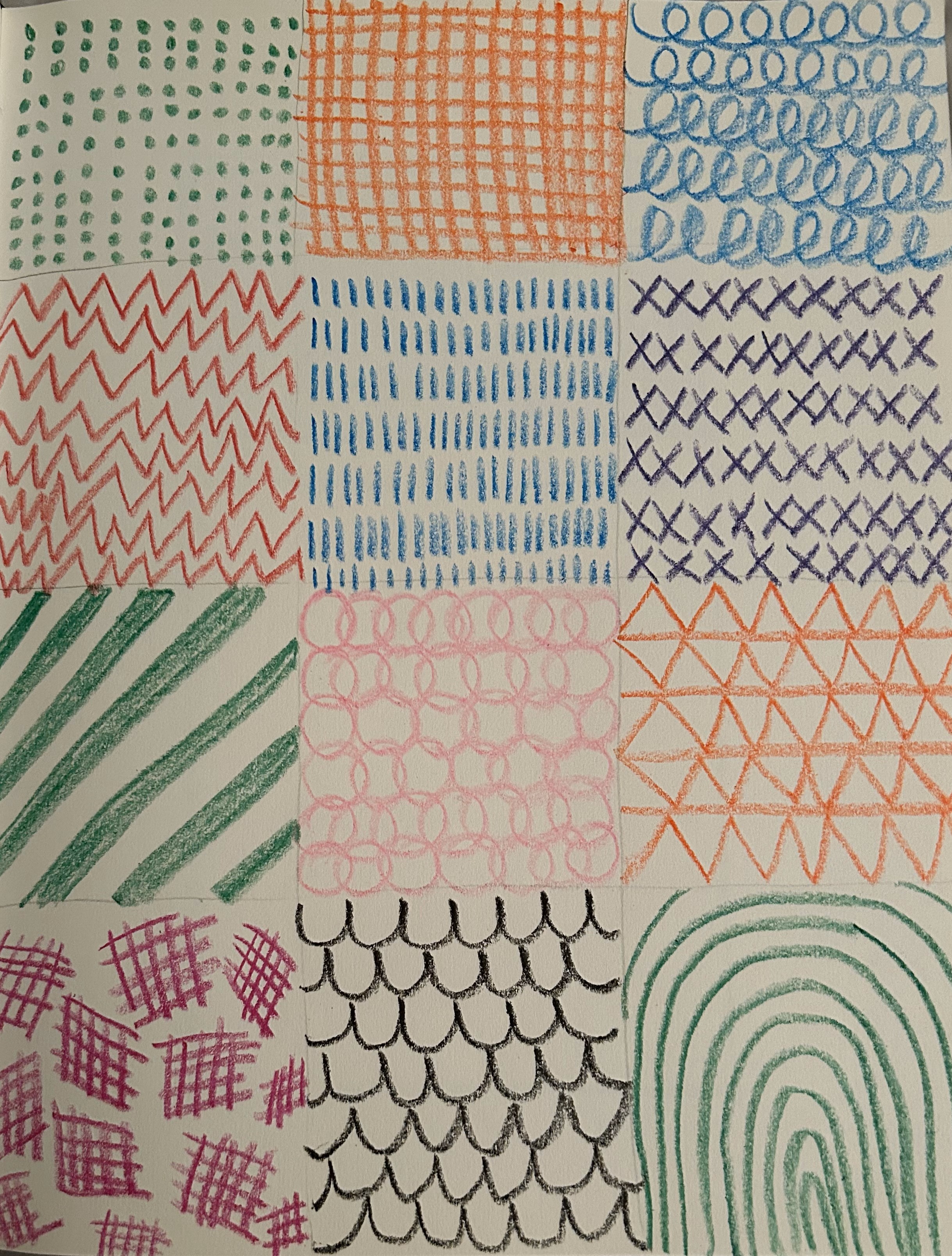
Now, in this moment, I feel that “making my mark” is simply making the marks. It’s the creative impulse to sew a stitch, use a colored pencil, write a few words, or play a few notes. The mark making is enough because of the internal change I feel–the internal affirmation that it feels good to put marks on a page. It feels good to play the piano. It feels good to write. That’s enough for me.

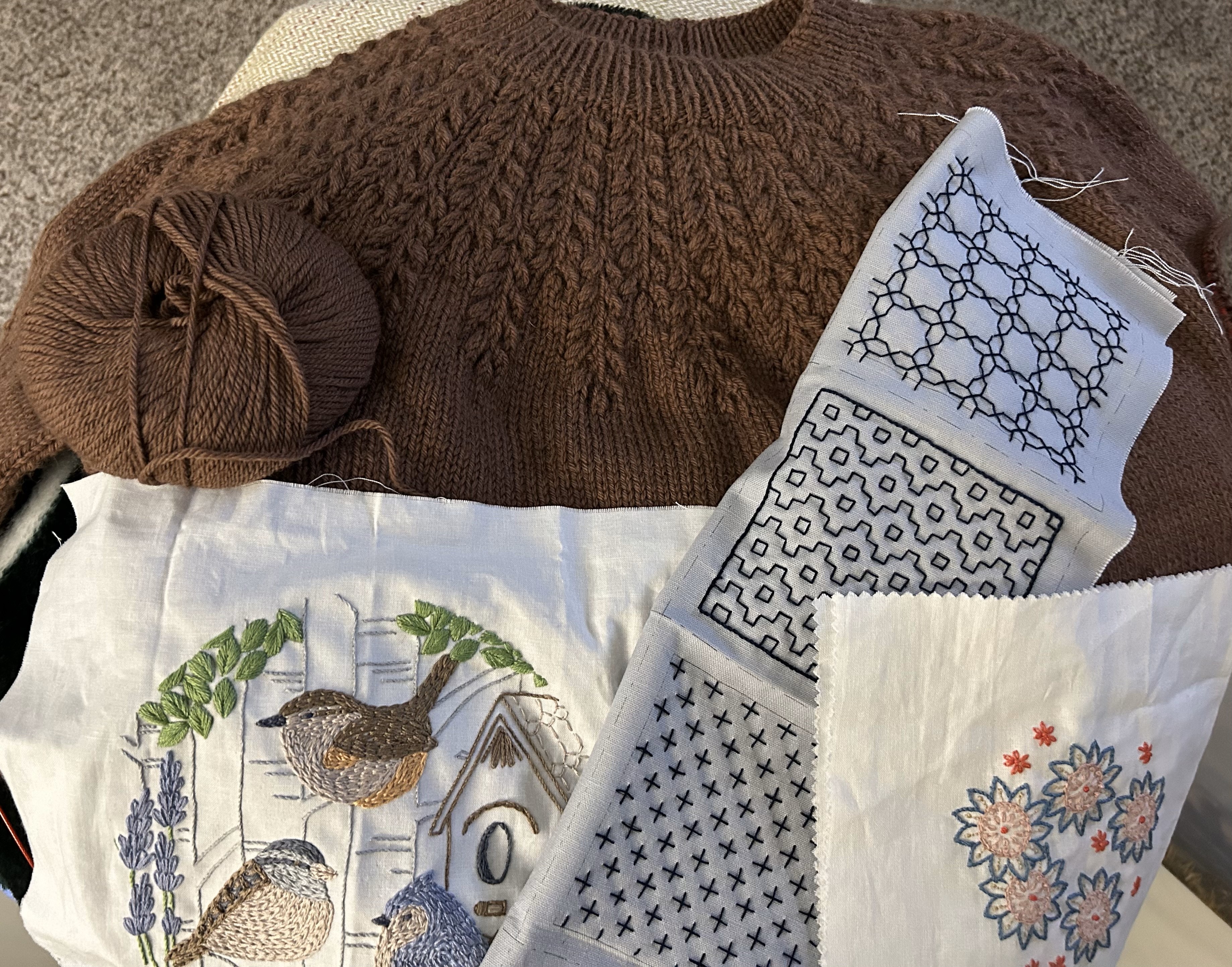
2024 knitting and stitching
My page from: “Developing Your Visual Vocabulary: A Daily Practice in Mark Making” Class by Lisa Congdon
Thank you to all who make this writing space
a place of safety, support, and beauty.

That Season

Photo courtesy of Unsplash

The love of baseball seems to run in families. Mine was one of them as my brother was quite a skilled player–catcher, hitter, 3rd baseman. My two sons played as they were growing up and now one of my sons is coaching 3 teams–a Little League Majors team, a travel club team, and assisting with a Little League AA team. That’s a lot of baseball.

I decided to walk a different path today at the local middle school. It was dusk and I figured I had just enough time before the sun set to get in a good walk. I noticed that there was a young baseball team having practice. As I walked I could hear the chatter of 10-year old boys joshing and hollering, laughing and living their best life. It made my heart so happy.

As I approached the backstop area, it was getting dark. A few parents had gathered to pick up their sons. The coach had the boys facing each other in two lines. On his command, one line started chucking 10-inch nerf balls at the other side. The coach called the outs. (If you got hit, you were out.) I’m not sure if there was any scorekeeping, but the boys were all in. I wondered if this was a team-building exercise, or a throwing exercise, but it really didn’t matter.

Kids outside together. Playing until the street lights came on. Building memories. That’s what mattered.

Thank you to all who make this writing space
a place of safety, support, and beauty.

Naming the Concept

I was listening to a podcast (yes, I do that quite frequently!) and had my mind blown by a concept called “the second simplicity.” The idea is that we often start with a certain simplicity, then enter a state of complexity, and come out the other side with a second simplicity that is deeper and richer than where we began. This is a natural progression, but somehow having a name for it is very cool.

An example was offered of a fifth grader playing Beethoven’s “Fur Elise.” The student has learned the notes, the rhythm, and perhaps something about the form of the piece. Later, that piano student goes deeper into the complexity of music including the life of Beethoven, his style and contributions to the Romantic period. Perhaps more study would include harmony, structure, dynamics, phrasing, and personal expression. After deep study, the pianist returns to “Fur Elise” with a deeper appreciation of its beauty and is able to add wisdom to the performance. Same notes played, but how the music is enriched.

I googled this concept and learned that Oliver Wendell Holmes put it this way:

“I would not give a fig for the simplicity this side of complexity, but I would give my life for the simplicity on the other side of complexity.”

All day, I was thinking about this as I cooked, cleaned, and tended to Saturday chores. I think the second simplicity certainly applies to motherhood (with grandmothering being the 2nd simplicity). I think it applies to teaching reading and writing, too. It’s another way of looking at anything we might struggle with or strive toward. Working through the complexity of the “messy middle” is usually rewarded with a profound sense of peace when there is an end to the striving. I love that now I have a name for that feeling–the second simplicity.

What do you think?

Thank you to all who make this writing space

a place of safety, support, and beauty.

From Fear to Form

In recent years, I have enjoyed exploring poetry. Through the magic of Zoom, I have learned about so many current poets and their poems. Reading poems has led to writing prompts and my own attempts at writing poems. I get a lot of pleasure in playing with words and forms.

One form, however, has intimidated me and I told myself a story that I couldn’t write a pantoum. Until today. I’m taking a 6-class series called “Poetry is Life” taught by Ann Quinn through Yellow Arrow Publishing in Maryland. We usually study three poems each session and practice writing from them. The form we visited today was, for me, the dreaded pantoum. It seemed impossible to think of a topic that could become a pantoum. I didn’t know where to start. I even considered not trying.

Carefully, Ann walked us through Natasha Trethewey’s poem, “Incident” and essentially mapped the lines into a code I could follow as I wrote my own poem. I also learned that pantoums often reveal a narrative with layers of meaning.

Here’s my first pantoum:

Fine

He says he’s fine
after blood drenched his tie
I’m good, he says
bright red spots down his white shirt.

After blood drenched his tie
a friend stopped to help
bright red spots down his white shirt
It will be okay.

A friend stopped to help
He didn’t have to
It will be okay
but she’s not sure she believes

He didn’t have to
speak soothing words and take slow steps
but she’s not sure she believes
and kindness sometimes lies

Speak soothing words and take slow steps
I’m good, he says
and kindness sometimes lies
He says he’s fine.

Isn’t it so interesting that we can change the stories we tell ourselves? Today, I’m happy that some of my fears of new forms were set aside. I learned that a pantoum is actually a fun word puzzle. I am grateful to have teachers and other poets to guide me.

Thank you to all who make this writing space

a place of safety, support, and beauty.