March 14, 2015

I’m one of the best procrastinators I know.  Perhaps that is why I’m a late poster.  Perhaps that is why my to do list is always impossible.  Perhaps that is why I get migraines. Perhaps that is why my sister, who finishes her to do list almost every day, laughs and shakes her head at me.  Even my mother gave me a poem in 1970 which she had found that reminded her of me.  (This was highly unusual behavior for my mother.)   Here it is:

“I Meant To Do My Work Today”

by Richard LeGallienne

I meant to do my work today,
But a brown bird sang in the apple tree,
And a butterfly flitted across the field,
And all the leaves were calling me.
And the wind went sighing over the land,
Tossing the grasses to and fro,
And a rainbow held out its shining hand,
So what could I do but laugh and go?

Actually, I meant to do my work today.  I meant to practice the piano for an upcoming performance.  I meant to prepare my lesson for church tomorrow.  I meant to do the laundry.  I meant to find the tax papers so they are ready for the yearly March Madness Tax Preparation ritual.  I meant to do some cooking.  I meant to write and post early. After all, it is Saturday. I meant to do so many things.

Instead, I slept away a migraine that had lingered for 3 days.  The good news is that I can try to do better tomorrow.   The good news is that baby Maggie will be here very soon.  The good news is that my family supports me even when I don’t function very well.  The good news is that spring is coming and soon the brown bird will be singing in the apple tree.
March 13, 2015

My daughter reported seeing a bunny on her walk today in Utah.  She was walking with long strides, hoping to self-induce labor (it would be very cool for her baby to be born tomorrow on Ultimate Pi Day).  I feel like the 2000-mile difference in our locations is more like infinity.  I’m waiting for my spring break to travel so that I can stay a longer time with her.  However, her bunny sighting instantly closed the distance-gap.  I “trained” my kids to report all wildlife sightings because it made me happy and because I always felt that it was important for children to observe and notice the natural world.  To take none of it for granted.  To appreciate beauty every chance they got.

I remembered driving my children to and from sports practices at twilight–a time we came to call “bunny time.”  We’d roll the windows down, smell the fresh air, and call out, “It’s bunny time!”  There were certain places in our routine travels where we could expect to see bunnies at twilight, especially during the spring when new grass and young, green shoots lured them from forest thickets.  Now that over-development has caused such imbalances in our local eco-system, I am more likely to see a fox than I am to see a bunny.  I miss the bunnies, but not as much as I miss my kids.

I have noticed the bluebirds are returning.  What a treat it is to see a flash of blue.

March 12, 2015

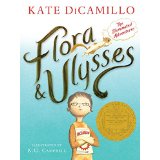
I love reading aloud to kids.  I’m having so much fun reading FLORA AND ULYSSES:  The Illuminated Adventures by Kate DiCamillo to my group of 12 fourth graders.  These students come from three classes and were selected to work with me for a variety of reasons, mostly having to do with motivation and comprehension issues.  A few of them try to be “too cool for school.”  Some try to mask difficulties or lack of success by not caring.  Some are not yet aware that they are not “getting it.”  A lot of fake reading has been going on.  My time with them is in addition to their regular language arts block.  I know I don’t have magic and I’m certainly not a perfect teacher, but there is the hope that I can somehow make a difference.  It’s a humbling responsibility, but a challenge that excites me.

Today they learned the joy of saying, “Holy unanticipated occurrences!”  I loved watching the transformation on their faces when they opened up enough to let themselves have fun saying those words. We said it a lot with feeling. You could see self-consciousness melt away for many of them as they laughed at the image of a squirrel covered with the dust from eating a bag of cheese puffs! For students who are pressured by today’s world to grow up too fast, to leave childhood too early, I feel happy when I can create a place or moment to let all of that pressure go and allow exuberance and hilarity in the classroom.  I know that memories are more powerful when emotions are attached.  When we can attach those happy feelings with reading books, we have taken an important step toward creating readers.

We’ve been discussing Flora’s view of herself as a cynic vs. her openness to the possibility of unanticipated occurrences.  We’ve had some good discussions about the contrasts and contradictions that make Flora an interesting character.  I’m not sure yet how this intervention will work out, but I have to trust the process that if positive experiences with books and reading are created and repeated, readers and writers will grow.  Will it be measurable on a test?  I don’t know.  Will it be measurable in a life?  I think it could be immeasurable or there may even be “holy unanticipated occurrences!”

March 11, 2015

Five years ago, I would probably have said that I read very little nonfiction outside of professional literature. That has changed for me. For escape reading, I would probably still choose a mystery, but I have come to really enjoy and seek out current nonfiction. I think the shift started for me through reading memoir, essays, and authors such as Malcolm Gladwell, Oliver Sacks, Michael Pollan, and Diane Ackerman.

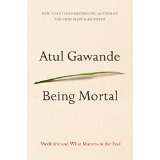
I read an important book this past week, BEING MORTAL: Medicine and What Matters in the End, by Atul Gawande. It’s a book that I wished I had been able to read during my mother’s final years, but it has now brought my awareness to issues that are important in every family. My husband and I are both youngest children with 10 older siblings between us.

Dr. Gawande writes beautifully of his own grandfather who lived to be 110 and his father (also a physician) who fought a rare cancer of the spinal cord for a number of years. It was facing choices about medical treatment vs. the desired quality of life all the way to the end of life that motivated the writing of this book.

There was a part of the book where he talked about human beings having both an “experiencing self” and a “remembering self.” These two selves often come to radically different opinions when viewing the same experience. He writes, “In the end, people don’t view their life as merely the average of all of its moments–which, after all, is mostly nothing much plus some sleep. For human beings, life is meaningful because it is a story. A story has a sense of a whole, and its arc is determined by the significant moments, the ones where something happens. . .A seemingly happy life may be empty. A seemingly difficult life may be devoted to a great cause. We have purposes larger than ourselves.”

Dr. Gawande recognizes the complexity of decisions facing the terminally ill, but also the simple truth that “all we ask is to be allowed to remain the writers of our own story. That story is ever changing. Over the course of our lives, we may encounter unimaginable difficulties. Our concerns and desires may shift. But whatever happens, we want to retain the freedom to shape our lives in ways consistent with our character and loyalties.”

I highly recommend this book to anyone who still has living parents or has family members or friends facing terminal illness, or old age. It gave me a lot to think about as I consider getting older myself. We tend to deny that fact in our society, but I appreciate that Dr. Gawande had the courage to write about a topic that most people want to ignore.

March 10, 2015

My dad
liked to quote:
Prior
Preparation
Precludes
Poor
Performance.

So,
Tonight
Planning
MUST
reluctantly
Preclude
Poetry.

March 9, 2015

A musician that had a great influence on the performers and composers in yesterday’s concert at the National Cathedral was Nadia Boulanger (1887-1979). She must have been a powerful teacher.  Among her pupils were Aaron Copland and Leonard Bernstein.  The organist said of her: “She taught us: Be a musician; be true to the art; serve the music, reach deeply for the heart and soul of the music. Only then can you touch the hearts and souls of others.”

Here are two other quotes I found from Nadia Boulanger:

I love how the arts crossover and weave together.  I think these quotes can apply to many disciplines as well as to music. The more we know about the “rules” of writing, the more free we are to intentionally break them. The second quote reminds me that to be a writer, a musician, an artist, a friend, a mother, or a teacher requires a level of attention that is heightened by the love and connection we have to life and living. “Life is denied by lack of attention.”  That may be one of my new favorite quotes. Think how much life is enhanced, enjoyed, and enriched by the attention we give to detail, to children, to humanity.

Today I started teaching 2 boys who for very different reasons are struggling readers.  One is a twin and has had developmental delays; the other is from a home where there is emotional and physical abuse. The first has difficulty with comprehension due to expressive language delays. The second is in crisis. He has chosen to go silent in school and produces almost no work.  I love these boys and have known them for a few years.  I hope that my time with them will be the attention they need.  I hope I can be a teacher, be true to the art, serve the child, and reach deeply for the heart and soul of the learner.

March 8, 2015

Today I treated myself to a concert at the National Cathedral. It was an all French-composer program by the Cathedral Choral Society, a small orchestra, and J. Reilly Lewis at the organ. I went because they were performing Gabriel Faure’s Requiem. I know and love this piece deeply, and it connects me to a time back in 1973. I enjoyed every moment hearing it once again. The music is ethereal and also deep. It’s like being on top of a mountain and recognizing the glory of the sky and the depth of the valley. I loved hearing it live, and in the cathedral, where every tone reverberates so richly, it was amazing.

In 1973, I participated in a 6-month study abroad in Salzburg, Austria through my university. We were 55 students with diverse backgrounds, and even more diverse reasons for wanting to go to Europe to “study.” Naive me didn’t know that some people would be there specifically not to study. So many memories can be written about that experience, but the one that connects to my going to the concert today involves choir practice.

I was raised on choir practice. I have written about it several times before. But THIS choir practice was held at the Mozarteum in Salzburg.  The Mozarteum is a music conservatory in the city where Mozart was born.  Students from my university who wanted to, were invited to participate with the Mozarteum choir in preparing and performing Vivaldi’s Gloria and Faure’s Requiem.  Living outside the city in a small village, we rode the train every Wednesday afternoon for an hour of rehearsal. At 19, I felt so grown up and so lucky!

I can’t recall our conductor’s name (I should go dig up my journal), but he was an Austrian graduate music student. I remember thinking he seemed more like Mick Jagger with his long hair, tight jeans, boots, wide belt, and perpetual cigarette. Yes, those were the days when people smoked as they worked. He had really bad teeth. I would have been terrified to talk to him directly, but I watched and listened and grew to appreciate the musician he was. Between our Schuldeutsch (school German) and his English, communication was interesting. Fortunately, conductors speak mostly with their hands and facial expressions.

Rehearsals mostly went well; other times, he got angry, frustrated, and disappointed.  I remember his passionate attempts to bring out more expression from us.  I think he had a conducting evaluation based on the final performance. So imagine the pressure he must have felt to get 75 college kids to sound like angels. But finally by spring, we had taken on Faure’s pleadings for mercy, for peace, for transcendence. I remember singing with my whole soul when the pleadings became my cries for mercy, for peace, for love.

March 7, 2015

After reading Rain Reign by Ann M. Martin, I reflected on being a family member of someone with a differently wired brain. This poem is a personal response to a different issue with brain-wiring that has touched my life.

Once I started a little poem,
“Keys, wallet, watch.
One, Two Three.
Our dear Steve
Has OCD.”
It wasn’t really very nice–
I knew it had a touch of playground taunt.
Maybe more than a touch.
I felt sorry.
I knew compulsions were real.
And the obsessions painful.
Yet, at certain times,
and over time,
some of the most difficult things
have given way to such endearing things.
For example, scooping ice cream so that
there are no dips in the top.
The ice cream remains pristinely flat.
Jello in a round bowl is eaten precisely
as jello pie.
Perfect triangles.
9×13 casseroles are evened out in rows.
No partial rows.
Our shoveled paths of snow are straight and neat.
Exemplary.

I imagine how hard it is to have a wife who rarely does anything the same way twice.

Sometimes when I park the car, I get an “A.”

I hope it helps.

March 6, 2015

Today I read over my posts from last year’s SOL Challenge. I was wondering if I might be able to tell if I have grown as a writer this year. When I look at student writing, I use rubrics to keep a record of their growth as writers. How will I know if I have grown? Using a rubric on myself somehow feels weird. I think that I’m going to postpone any judgment for now.

The important thing is that I’m here again trying to improve. Mostly, I notice that I’m happier because I’m writing. As a person who has struggled with depression for most of my adult life, being happier is a big deal to me. There is something about the act of writing that satisfies a need, turns my mind outward toward the world instead of inward on myself. That seems like a paradox, but even though the act of writing is personal, once written it is part of something bigger than myself. If I’m honest, writing is empowering, and that feels good. (I’m fighting the urge to delete that sentence, but I won’t because it’s true.)

I hope that many of you are also feeling happier just by writing. Thank you to each one who makes this community possible.

Just a little reflection on a Friday night when a story isn’t coming readily to mind.

March 5, 2015

As my daughter, Jill, approaches delivery of her first child, we have had many conversations that have brought back many memories. Tonight we were talking about hospital stays and what she might need to take and what it would be like. So much has changed since I had my first baby 38 years ago. One thing she mentioned is that all new mothers have a private room now. I always had a roommate. Another new mother, a stranger to me, separated by a curtain. Sometimes it was nice to have someone to chat with; other times I nearly went crazy hearing only half of hours of phone conversations.

My favorite memory of being a new mother with a roommate was with my second son (1980). I had been induced and had a fairly easy birth (relatively speaking, of course). He was notorious even before he was born. I remember the nurse shouting out to the other nurses when she checked me, “He’s got white hair!” My Tim had a full head of white-blonde hair. He was beautiful.

My roommate was about 10 years older than I was and was from the Philippines. I was fortunate to have the bed by the window. She was very sweet and quiet as I recall. Early in the morning the day after our deliveries, she peeked around the curtain. She held her baby with his full head of black hair. She said timidly, “Excuse me, may I borrow morning sunshine?” I wasn’t sure how to reply, but welcomed her to the window. She explained that in the Philippines, it was customary to bring babies into the morning sunshine to prevent jaundice. I had never heard of that before, but it made me happy that I got to learn about her ways.

Again very early the next morning, she asked, “Excuse me, may I borrow morning sunshine?”  I smiled. I felt differently about sunshine in the morning. I felt differently about mothering. It was my first time sharing motherhood with someone from another country. I knew she had taught me something important–even though I couldn’t put it into words. Even now, I’m struggling to express why that memory is so dear to me nearly 35 years later. I think perhaps it is just the simple act of love. The mother doing her best for her baby in the ways that she learned from her mother.

As I told Jill the story of “May I borrow morning sunshine?” we felt close. A simple act of love. Perhaps she will bring Maggie into morning sunshine and remember.