My baby girl is pushing
Hee hee hooooo
Her baby will be here soon
Hee hee hooooo
I’m 2000 miles away
And I can feel the joy
Hee hee hooooo
All the way across country
Can’t wait until Thursday
When I can hold them
Both in my arms.
Blessings for all.
My baby girl is pushing
Hee hee hooooo
Her baby will be here soon
Hee hee hooooo
I’m 2000 miles away
And I can feel the joy
Hee hee hooooo
All the way across country
Can’t wait until Thursday
When I can hold them
Both in my arms.
Blessings for all.
When Jill gets nervous, she says, “Oh gosh.” The number of “Oh, goshes” is in direct proportion to the amount of fear and anxiety she feels. When I took her to college the “Oh goshes” started days before freshman orientation. We tried to combat it with Ben Folds’ song, “Still Fighting It.” We sang that song over and over. But “Oh gosh” usually followed.
Tonight Jill knows that at 6:00 a.m. tomorrow morning she is to be at the hospital to have her first baby. She is a week overdue. She told me that the “Oh goshes” started last night. Who isn’t afraid the night before life changes forever? Once you become a mother, there is no going back, no career change, “no way out–but through.” I tried to acknowledge that her fears are normal and that everything will be fine. What is so hard to communicate is how much you can love a little person and how nothing else matters when the baby finally arrives.
When you go off to college, it seems natural to fight growing up, but when you become a mother, it seems natural to fully embrace becoming the grown-up, the nurturer, and the protector of a brand new life. I’m so excited for her I can barely contain myself!
“Still Fighting It” by Ben Folds
Good morning, son.
I am a bird
Wearing a brown polyester shirt
You want a coke?
Maybe some fries?
The roast beef combo’s only $9.95
It’s okay, you don’t have to pay
I’ve got all the change
Everybody knows
It hurts to grow up
And everybody does
It’s so weird to be back here
Let me tell you what
The years go on and
We’re still fighting it, we’re still fighting it
And you’re so much like me
I’m sorry
Good morning, son
In twenty years from now
Maybe we’ll both sit down and have a few beers
And I can tell you ’bout today
And how I picked you up and everything changed
It was pain
Sunny days and rain
I knew you’d feel the same things
Everybody knows
It sucks to grow up
And everybody does
It’s so weird to be back here.
Let me tell you what
The years go on and
We’re still fighting it, we’re still fighting it
You’ll try and try and one day you’ll fly
Away from me
Good morning, son
I am a bird
It was pain
Sunny days and rain
I knew you’d feel the same things
Everybody knows
It hurts to grow up
And everybody does
It’s so weird to be back here.
Let me tell you what
The years go on and
We’re still fighting it, we’re still fighting it
Oh, we’re still fighting it, we’re still fighting it
And you’re so much like me
I’m sorry
Right now, I am:
distracted:: so many things on my mind
waiting:: still waiting for Maggie!
sorting:: papers, papers, papers
washing:: clothes, dishes, and counter tops
reading:: Wild, the story of the woman who hiked the Pacific Crest Trail
savoring:: Brown Girl Dreaming, by Jacqueline Woodson
cooking:: meals for my husband while I’m gone to Utah
knitting: the last square of Maggie’s blanket
planning:: an inservice using Notice and Note (Beers) strategies
smiling:: the day has brought happy moments to be grateful for.
singing:: I heard a lovely Easter concert tonight. Who does not love Brahms’ Requiem?
My mom never owned or wore a pair of jeans. She was in her fifties (1970s) before she ever wore pants. Even then she wore knee-high stockings and dress shoes with her slacks. Later on, when walking became more painful due to arthritis, she would wear walking shoes that were leather and still dainty. No clunky shoes, no athletic tennis shoes ever. She got her hair done every Friday and always wore lipstick if she was going out. She always smelled so good.
When I was little and before she started wearing pants, she always wore a “house dress” to do her work at home. All the dusting, vacuuming, cooking, baking, scrubbing, and laundry was done wearing a dress. Every afternoon when her housework was finished, she would stop, take a shower, and change to a “nice house dress.” She would then put on her strand of pearls that my father had given her for their wedding. Next, you would see her sit down and read the afternoon newspaper, “The Washington Star” as dinner cooked. Back then, Washington, DC had a morning and an evening paper. She read the paper front-to-back, even the sports, which helped her connect to my brother’s world of sports and my father’s world of government service. Dinner would have been timed to have everything ready on time as Daddy walked through the door. It mattered to her that she looked nice, smelled good, and was not rushed when he got home.
Mom was a lady. She had been raised by her grandmother and mother as her father died when she was only six. It was a household where the work was shared and the work done early in the day. They were fortunate to be able to keep their home during the Depression by taking in laundry and sometimes boarders. She told me that her home had a proper “parlor,” a room that was only used when guests were present. To be in the parlor you had to be dressed in your best clothes, mind your manners, and be a lady. She was taught that a lady never runs, never rushes, and is gracious in all settings. The interesting piece is that while my mother followed all the rules, she was also a quiet rebel. She left home at age 20, rode a train across the country, by herself, to pursue getting a job in Washington, DC during the war years (1942). She was a gifted musician with perfect pitch, and she worked hard to develop these talents. She was a quiet woman, but she had inner strength that could be fierce. In her last 5 years, I would say she was a lady with grit. The amount of pain she endured day after day never broke her ability to be proper and gracious. My sister fixed her hair every Saturday. She still wore lipstick. She expressed appreciation often.
Today our lives are more complicated, moving faster, and casual dress is the norm. I confess that I can’t wait to get home from work to be able to put on my sweats. I don’t like to work in a dress, and often I don’t remember lipstick–much to the chagrin of my sister. I don’t often have dinner planned and ready as my husband comes through the door.
I dream of living a gracious life, but I realize that the drive to be constantly working, always striving, and trying to keep up with the busy, contemporary world make that dream difficult to achieve. I guess I can just hope that one day, I’ll be the gracious lady in her sweats.
As I sit on my couch and struggle with what I might write about tonight, I realize that I haven’t articulated for myself what makes writing hard for me. The writing process is complicated and emotional. Sometimes thoughts, poems, and stories flow relatively freely; other times, writing is a treacherous climb, a wade through the mud, or a trek across the desert at night. I have been sitting here for an hour starting and stopping, fighting with my inner censor. The censor has so many voices–voices that say:
“That’s dumb.”
“That reveals too much.”
“That’s already been said better by so many people.”
“Yeah, that’s a cute memory, but what makes it worth writing about?”
I write and delete. Write and delete. I realize I need to acknowledge my own vulnerability and take on that inner censor, but tonight, it’s too scary.
Many times I hear teachers say that kids don’t write because they haven’t had enough life experiences. That always makes me cringe because I know that all experiences are writing topics. Perhaps it isn’t the lack of life experiences at all that inhibits student writing. Maybe, like me, they have inner censors that are shouting in their mind’s ear. So, perhaps the more important question is, “How do we help kids recognize their inner censor and give them tools to fight back?” What are some tools for fighting back? Maybe quieting the censor is not even a fight, but a letting go.
Here are 10 things I have to get off my mind, even though just putting down a few words feels beyond me tonight:
My daughter’s baby was due yesterday. Today she cried. She’s so ready, but so unsure of herself. I wrote this for her.
My Lastborn, Her Firstborn
I swaddled, lullabyed,
fed and bathed her.
No one told me
How much I could love her.
Soon
I’ll be reminding her
that she knows,
as all mothers know,
what she needs to know.
She doesn’t believe me now.
But she will.
Most people I know don’t wear aprons anymore. I guess some foodies, chefs, or bakers do, but the daily wearing of aprons for home cooking, is probably a thing of the past. Like many pieces of my past, aprons bring nostalgia.
My mother had a lovely assortment of aprons. She had everyday aprons made of inexpensive, floral-print cotton. Some she embroidered. I remember her making many aprons from all colors of gingham fabric. She used black embroidery thread to cross-stitch designs along the bottom of the apron. My favorite was a lilac gingham apron with little windmills and dutch girls. I wished that one could be mine, but I was only 7. Sometimes she gave these aprons as gifts or donated them to sell at the Church Bazaar.
Mama also had Sunday aprons that were a little fancier. They were made from organdy (a dressy translucent fabric), trimmed in lace or with ruffled edges. But even those were not as fancy as her party aprons which she got out for when she had invited guests for dessert or other social events. As a child, I could often take cues for my behavior based on the apron mama was wearing. I knew that the fancier the apron, the more I needed to stay out of her way and be as helpful as possible.
An apron is a simple piece of clothing, but to me, an apron is love.
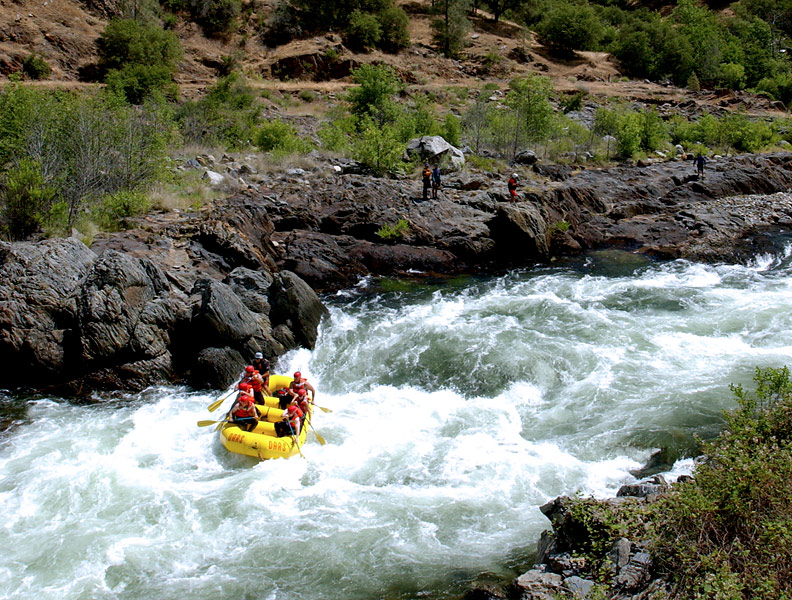 If you go whitewater rafting, you are probably going to be told some rules. Rules such as:
“Stay in the boat.”
“Wear a life jacket and helmet.”
“Hold on with both hands.”
I was thinking today how much teaching can feel like whitewater rafting. The pace is fast. The challenges are as varied as the rivers and classes of rapids. The water temperature and the weather are factors which affect the experience. There is beauty all along the way, but we have to focus on the river and staying in the boat more than we can focus on the scenery passing by. We must be present in the moment. Dangers lurk below the surface such as suddenly shallow waters or boulders older than time. More and more, teaching can feel like a dangerous sport.
So what makes me stay in the boat? What helps me hold on with both hands? What serves as my life jacket and my helmet? I think hopes and dreams help me stay in the boat. Hopes for reaching a child. Dreams of change in education that might actually honor a child’s need to play, honor everyone’s need to belong, and the need to live purposeful lives. I hold on with both hands to my beliefs about reading and writing. To the belief that words can make peace and kindness. To beliefs about the “glory that can light up the mind” (Steinbeck). I want that for all children. My life jacket and helmet are my family and the fine teachers who mentor and inspire me.
For now, I’ll stay in the boat and hang on for dear life. Yes, dear life.
Back in October, 2014, several things happened that “rocked” my world, and I struggled with depression. It was all I could do to get up and go to work, make it through the day and do it again the next. Sometime during the following months, the image of being a ball on a pool table came to my mind. I felt like I kept getting hit from out of nowhere and I’d be sent in directions that were not of my choosing. I’ve been wanting to draft a poem to express some of this. . .here’s a VERY ROUGH draft that hopefully, I can revise and improve. Suggestions welcome!
If my life
Is like a billiards game–
the balls racked,
connected in a perfect triangle–
Then possibility is high and order is established.
But if,
When the break comes,
And the cue ball comes from anywhere
Sending me in unanticipated directions,
Then, do I stay on the table
To take the hits again and again,
Or hope to find the
Pocket?

