Orange Jello

After a difficult night of GI distress, I woke up and wished I had some Jello. Jello made by my mom. I’m a grandmother and still wish I had my mom, especially when I’m sick. Lacking the energy to get up to make Jello, I stayed in bed and read The Great Alone by Kristin Hannah. Reading in the morning is the only good part of being sick.

Later, I shuffled out to the kitchen in my grape-purple fleece robe and slippers and scrounged around in the cupboards. Jello! I opened the box and poured the sugar mix in a pretty bowl. It took a few minutes for water the to boil. I waited and stared out the kitchen window.

When I poured the boiling water into the bowl, the warm orangeness took me immediately to my mother’s side in the kitchen at 1634 Cecile Street. I saw again her beautiful hands stirring gently, the spoon making tiny circles in the hot liquid. She was always careful to be sure all the gelatin dissolved. I felt again the softness of her arms and could smell her freshly powdered skin. I was probably in the way, but she never said so. She just quietly went about her work.

I think my mother believed Jello worked magic. Whenever we were sick, she let us pick the color and she would make us our own bowl of plain Jello. Coming from the West, she knew hundreds of ways to “dress up” Jello, most of which I didn’t like. I was a picky eater then.

Green Jello with canned pears. Orange Jello with mandarin oranges and bananas. Orange Jello with grated carrots and pineapple.  Red Jello with canned frozen raspberries. Grape Jello, lemon Jello and blackberry Jello, on occasion. For Thanksgiving, red Jello with cranberry sauce, celery, pecans, and crushed pineapple. Thankfully, she wasn’t too much into making the Jello with cream cheese or Jello with cottage cheese, but she did enjoy it when other people did. For a while, it was popular to add Coke, Sprite, or Pepsi to your Jello. That made it really special. Once I was even offered green Jello made into a mold with chicken salad ingredients – chicken, celery, eggs, even mayonnaise. Not my favorite.

By now, my bowl of plain orange Jello will be set and when I scoop it out of the bowl and it makes that slurping/sucking sound that only scooped Jello can make, I’ll smile and remember my mom. I’ll eat it slowly and let it dissolve in my mouth, knowing I’ll feel better soon.
Time

My friend, Sally, posted today about time. She observed that while each day has the same 24 hours, the amount of time we feel we have can vary from day to day.

That makes me think of the time spent each March writing and reading all the wonderful posts at Two Writing Teachers. Why am I able to carve out time each day in March to write, but the rest of the year I am more sporadic? I guess it’s about the commitment, the challenge, and the desire. Nothing new there.

I think what is new(er) to me this year is how lost I can get in reading and responding to other bloggers. I love reading blogs with different voices, different forms, and different life experiences. What I notice and appreciate is how so many are willing to take risks, to share teaching plans, reading responses, and heart-wrenching stories. I read one and then I tell myself, “Just one more.” Then, another and another. I’m going to have to put myself on a blog budget!

Our humanity is affirmed through our sharing our writing.


Embers

the baby’s breath
the flutter of wings
the quake of aspen leaves
the air through a flute
the breath which scatters dandelion seeds
the whispers of morning air
the weary exhale

each is enough

to spark embers of fire


Thoughts on Play during Yoga

My Saturday mornings are usually spent with an hour of personal training followed by an hour of gentle yoga. The hour of gentle yoga is the reward I give myself for doing the strength training first.

I’m just recently getting back to exercise after an extended illness. It has been challenging! I didn’t realize how much and how fast my strength and stamina had declined. I heard recently that as we age we lose muscle mass at an accelerated rate. It takes more work to maintain strength and balance as we age.

Today our yoga class was focused on the intersection of the psychology of play and the philosophy of the Yoga Sutras. It was such a fun class and gave me a lot to think about educationally. The five big ideas of play are described by Peter Gray, Ph.D in an article from Psychology Today. It’s not a new article, but it still rings true. You can access it here.

(1) Play is self-chosen and self-directed. Yoga teaches us to study the self and notice how our choices impact our bodies and minds. So we did “Happy Baby” and wiggled our fingers and toes any way we wanted. Are children getting enough opportunities to choose and direct PLAY?

(2) Play is activity in which means are more valued than ends. Yoga teaches that we are all on a path of growth and that wherever we are is part of the process of becoming. So we played with modifying poses in creative ways, even silly ways. Do we give our students room to experience process more than product?

(3) Play has structure, or rules, which are not dictated by physical necessity but emanate from the minds of the players. The postures of yoga are only part of a practice leading to peace in the mind. So we played with doing a movement sequence while keeping a small paper plate balanced on our palms. Do students get opportunities to create the structures or rules to implement their ideas?

(4) Play is imaginative, non-literal, mentally removed in some way from “real” or “serious” life. Yoga is the time in our busy lives when we can unplug and free ourselves from the cares of work, family, and the world. So while we did tree pose, we tossed a tennis ball and then bounced a tennis ball. A few balls got away and we laughed. That reminded me of the magic of reading aloud. Read aloud. Read aloud. Read aloud.

(5) Play involves an active, alert, but non-stressed frame of mind. Yoga teaches us to be present and to enjoy the space that exists between effort and ease. Are we making our classrooms places where being active and alert learners is valued without putting pressures (like test scores) on them?

I am going to try to practice more playfulness in my life, my writing, and my work.


Kwame!

Our 4th and 5th graders participated in a webinar with Kwame Alexander today. The webinar was to celebrate Read Across America Day and was sponsored by Learning Ally. As soon as Learning Ally announced this free event back in November, I registered our school. I didn’t care that I had no clue what would be happening on March 1, 2019. I just knew I wanted our students to have some exposure to this giant-hearted author.

Kwame’s (I don’t know why I feel I can call him by his first name, but it feels good.) theme was “Say ‘Yes’ to the Possibility and Power of Poetry.” He shared the story of his reading life and development as a poet. Kwame involved the students by having them participate verbally in saying “Yes!” He pumped us up with his positivity that we can change the world one word at a time.

He shared a lot of things about his books, but the words that really caught my attention went something like this: Books are amusement parks and kids gotta be able to choose their own rides. Such an important message that we have to keep fighting for.

The other poignant moment for me as a writer was when he said that poetry has to have the right ingredients and be prepared well (like good food) for people to want to come back for more. He used a meal of fried chicken, mashed potatoes, and mac ‘n cheese as an example. Would you return to the home where the fried chicken was raw inside, the mashed potatoes runny, and the mac ‘n cheese dry? Or would you want to return to crisp, fall-off-the-bone fried chicken, fluffy mashed potatoes, and mac ‘n cheese made from scratch with 5 different cheeses? I had to ask myself if I’m writing in a way that makes others want to come back for more. What should I change? Is it the ingredients or the presentation that needs work? As I write that question, I know it’s both.

All to say, there was a happy outcome – all three fifth grade classes are going to listen to The Crossover. Kids practically begged the librarian to be first to check out our two copies. Others asked their teachers to load it on their Learning Ally accounts. Yay for reading!

Reset

Yesterday I started with a new intervention group of seven third graders. It did NOT go well. I think they felt embarrassed, or something, because the giggles and elbow jabs didn’t stop for 30 minutes. Not a good way to begin.

Today I decided to push the reset button with honesty and intention. I began by acknowledging that I wasn’t happy with how things went yesterday and figured they probably weren’t very happy either. Next, I explained that we weren’t just doing another ABC group. We would actually be delving into the nitty-gritty of the English language and learning so much about how words work and how we apply word knowledge to get more knowledge.

I recognized and praised the accomplishment of each of these students as English learners and reminded them that when other students were learning phonics, they were learning the names of things in English. I expressed my strong belief that in the long run, bilingual students have so much to offer the world.

Finally, I reminded them that when I asked them if they thought a group to help them “get words off the page” would be helpful to them as readers. They all said they needed help with that and this group was something they wanted to participate in.

I learned again that being honest and up front with students goes a long way in the intervention process. They know their needs and when we confirm and name those needs, it relieves them of the pressure to keep faking it. The change was

What a difference in today’s lesson. I love teaching.

February 19, 2019

You might have noticed that I gave my blog a little face-lift. I’m looking forward to the March SOLSC as it will be my sixth year! I began writing more intentionally and started my blog late in February 2014. I have never regretted the time I have spent here writing and the time spent reading your blogs at TWO WRITING TEACHERS. There is so much to learn and so many different ways to grow in this process. It was growth to risk my first poem, my first photo upload (don’t laugh), and my first comment to another writer. Now I’m trying to continue to grow as a writer and a user of this amazing technology.

Changing my blog theme felt overwhelming. I picked my previous theme the first year I participated in the SOLSC. Do you want to know how I picked it? I chose the same theme of the person who gave me my first comment on March 1, 2014. I remember thinking: if I use his theme, will my writing seem as better? I couldn’t believe I got such a beautiful response on my first day!

So, changing themes. How do you decide what looks good? How do you handle over 400 choices? Should your theme match your blog name? Does anyone care or think about that stuff? What about headers? Do you use the ones provided, or do you use your own photo? And what about color schemes? Does this come naturally to everyone but me? To help calm my fears, I did what I always do. I bought a book: WORDPRESS FOR BEGINNERS 2019. I definitely feel like I’m still a beginner and have a lot to learn. Over the next few weeks, I’m going to work through this book and try to understand and use more features. Maybe you’ll see some!

Reflecting on my five years of blogging there are some things I wish I’d known and done from the beginning. First, I would have titled my pieces, rather than just dating them. As a growing writer, I think I need to give my posts the respect of a title. Isn’t that what I would want my students to do? Honestly, I see my practice of using the date as a title is either lazy or just a safety net – a way to avoid commitment to my work. Another area for growth.

Next, I wish I had had a little more blogging savvy and set up categories and tagged my writing from the beginning. Now I have this nagging feeling that I really need to go back and add those things. Especially now that I wonder, “Did I already tell that story?” Any advice or tips you can give me are welcome.

I appreciate you, dear Reader, more than you know.


February 5, 2019

A reflection on a month of my OLW: Lift.

Today I’ve been considering why we call so many of the things that lift us “the little things.” Is it that they are often surprising, small moments of beauty, clarity, or wonder? Does the fleeting nature of seeing a gorgeous sunset, a pair of cardinals, or a soaring red shouldered hawk qualify the experience as little? Certainly for me, the lift from such things is anything but little.

And what about words that lifted me today? Nothing earth shattering. I was walking on the bike path and am used to the “passing on the left” warnings, but then a biker passed and said, “Good evening.” There was a musical quality to his voice. I replied the same. A moment in time. A kind exchange. A lift.

On my walk, walkers and riders passed me frequently since it was unseasonably warm (74 degrees in February in Virginia!) and I heard Korean, French, German, and Spanish. Languages are so lovely to hear, even when you can’t understand.

I’m grateful for all that lifts me. I hope I lifted others as they went through their day. I told a student that his persistence was impressive. When I asked if he knew the word “impressive,” he tried really hard not to show the pride he felt inside. He is a 2nd grader who tries to be “cool.” He’s a capable, natural learner. I look forward to watching him grow.

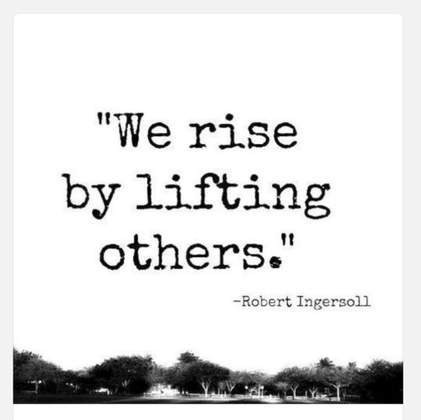
I thanked a colleague for giving me needed reminders twice today. She saved me some embarrassment and the day was better because of her. I like the quote below, and know the inverse is also true: I am lifted when others rise.

famous-quotes-about-helping-others-quote-addicts-915118
Image from Google Images


January 29, 2019

My friend, Sally, challenged me to accept Kwame Alexander’s writing prompt, “Love is…”

So here is a draft of my attempt:


Love is complicated.

As my friend sits at her mother’s bedside

waiting

I think of how unique each death is, just as individual as each new life.

Love is in how we live between our birth and death.


Love is hard; and

Love is multiplicative.

Two become seven

Then seven become twenty-four.

The heart makes room for more.


Love is messy:

when all your clothes have spit-up stains on them,

when your house is an eruption of toys every afternoon by five,

when your heart breaks again

and again.


Love is healing.

Making the complicated simple.

Softening the hardened edges.

Love is remembering the mess

and longing for its return.

January 22, 2019

Like so many others, I mourn the loss of Mary Oliver, poet. Her poems have lifted me more times than I can count. She changed the way I view the natural world and showed me how to attend to the small things, but to never take them for granted. She said that attention is the beginning of devotion. Her writing has brought me solace, fed my longing, and delivered beauty time after time. I am deeply grateful to her and her daily habit of walking and writing. This outwardly simple habit has rippled out to bless the world. It’s a habit I’m working to develop in my own small way.

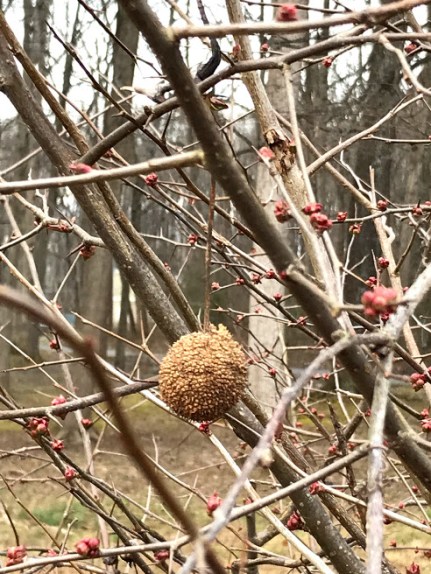
Such was the day, not too long ago, when I was walking in my neighborhood and saw a sycamore ball precariously hanging from a thin branch of a shrub I couldn’t name. It caught my eye. I looked up to search for a nearby sycamore, but didn’t see one. I wondered how far the wind had carried this seedglobe and how it happened to drop at just the right speed to be snagged on this twig on this day when I would be passing by. How long would it dangle there, safe from the woodland squirrels, chickadees, finches, and juncos? It was like a holiday ornament on the red-berried branch to decorate the gray day.

img_8348