In my sister’s house there are definite things that are done upstairs, and definite things that are done downstairs. When our kids were growing up, my kids knew that when visiting their cousins TV watching and play of all sorts were done downstairs. Upstairs was for sharing a meal, conversation, or listening to music. Our kids are now grown and “upstairs, downstairs” activities recently took on a new meaning.
My sister and I have been able to spend more time together now that we are both retired. We often meet for an afternoon of conversation and knitting. We have taken some online classes, followed @Knit1chgo (a cool knitting store in Chicago), and tried new patterns. Recently, we have taken on the challenge of knitting with multiple colors, known as colorwork. This involves reading charts, counting stitches, and working with several balls of yarn at once. There are many opportunities for mistakes.
“This is really fun,” said Evelyn. “I wish I had learned to do this earlier in my life.”
“Yes, but earlier, we probably didn’t have much concentration power left over after working all day. Knitting was a mindless way for us to relax and unwind from the day,” I replied.
“True.”
“I can’t watch TV and do this colorwork,” said Evelyn. “So this is my upstairs knitting. I need to get an easier project for downstairs.”
“Haha! Upstairs knitting and downstairs knitting.”
We now have a new way to characterize our needlework projects. Can it be done downstairs?
My Upstairs Knitting – Ranier (pattern by Kate Gagnon Osborn
A wonderful community of Teacher-Writers supported by twowritingteachers.org
I have read this term before, but it wasn’t until last night that I got to learn more about it. It was our last class with Georgia Heard in this series of classes. She taught us that Ars Poetica is a term for a poem that is a meditation on the art of poetry, the poet’s beliefs about poetry, where poems are found, or what poetry could be in an individual’s life. This form of poetry dates back to Horace in 65 B.C.E. and has been part of poetic literature ever since. We read Ars Poetica by Pablo Neruda, Lucille Clifton, Jose Olivares, and Georgia Heard.
I am a beginner on this road; a novice at poetic forms and techniques; an emerging reader and writer of poems. I’m enjoying being a learner and am trying new things in my writing. This community has contributed to my having courage to do this.
Georgia gave us an exercise which I will share. Perhaps your students would take these questions and create something truly wonderful.
What kind of animal is your inner poet?
Who does your inner poet speak to?
What does your inner poet say?
In our group, these were the animals chosen: lion, spider, wolf, owl, haw, doe, deer, sparrow, striped bumblebee, and hummingbird. It was remarkable that there was so much variety. We did it as a quick write in the moment. Here is what I wrote last night. It is a DRAFT, at best, but I share it to give you an idea of something you might try.
Ars Poetica
My inner poet is a great blue heron standing still in hidden wetlands.
It speaks to the tides flowing in and out. It speaks to quiet souls who weep.
It says, Be patient. Wait for the miracle. Watch and wait.
Thank you to all at Two Writing Teachers who support teacher-writers in growing as writers.
Today was pretty much an ordinary Monday with dishes to do, sheets to change, library books to return, and a quick run to Target. I was on the lookout for a slice. Nothing felt right.
Even though the cherry blossoms have burst open; even though daffodils are shouting their joy to a blue, blue sky; even though it felt wonderful to be back inside the library and to walk out with a stack of books; the stories wouldn’t come.
But then, ding! ding!
The miracle of technology allowed me to share in this big event. A huge event for this just-turned-six Kindergartener. I love her enthusiasm and irrepressible joy in life. She’s a special one.
I know this has been a different year for you. You have not been in the classroom with your friends. You are naturally shy; you didn’t really get to finish first grade strong last year when the pandemic began. Maybe you have forgotten that your small moments are important.
I’m proud of you for working hard at your reading. You are getting in to some really great stories now. I know that you like the stories with strong characters who can solve problems.
Guess what? YOU are a strong character who can solve problems, figure out stuff, and notice new things. I’m really looking forward to our time to have fun working on our writing together. Already, you came up with four really good ideas for stories you can write. I can’t wait to read them.
Love,
Mrs. Miner
Today was the first day of my writing time with J. He’s in 2nd grade and has been homeschooled this year. I’m grateful his parents are trusting me to help him with his writing development. After all, writing IS my favorite thing to teach.
Tonight my teacher-heart feels like this:
Thank you to the writers and leaders at Two Writing Teachers for creating opportunities for teacher-writers to share.
Over the last few years, I have been happy that my son is experiencing success as a husband, father, accountant manager, and baseball coach. He is in those very busy years. I admit sometimes I have wondered if I know how to be the mother or grandmother he needs me to be. Sometimes it even feels that I’m not needed.
People always said that a successful parent works themselves out of a job. The kids grow and establish themselves as adults. I get that. It’s probably true. I’m happy my kids are high-functioning adults, but there is sometimes a loneliness I feel that is hard to describe.
Today, I took my son to have surgery he needed. On the way, he was very quiet. I knew he was nervous, and I struggled to find words to comfort him. I found myself missing MY parents. I wanted to ask them how to do this phase of life, (parenting adults) but they are both gone. I kept my thoughts to myself and tried to be calm and reassuring.
On the way home, he was still coming out of the effects of anesthesia. It lowered his guard just enough. He was actually pretty hilarious–singing, and asking funny questions. He sang a high note. “That’s a C-flat.” Haha. Then, a low note. Then he sang some of Bach’s “Air for G-String.” So amazing how fast his brain was circling.
He asked me several times, “Did they get it? Did you see it? I didn’t die, right?”
But then he said, “Thanks for taking me, Mom. You’re a great mom. I’m a lucky boy.”
As a music student, I was introduced to the concept of musical forms such as the sonata, fugue, or symphony. My teacher felt that a study of form across disciplines plus a study of how to listen would provide a deep education for anyone who pursued that path. I became a better listener of music when I knew more about form.
Fast forward nearly 50 years and I am back in the study of form. This time poetic form. My task this week was to write a poem in a form created by Marilyn Singer called a Reverso. You can read about the form and her poetry here. I have struggled to write such a poem, but I did learn a practice technique that helped me.
First, draft your thoughts.
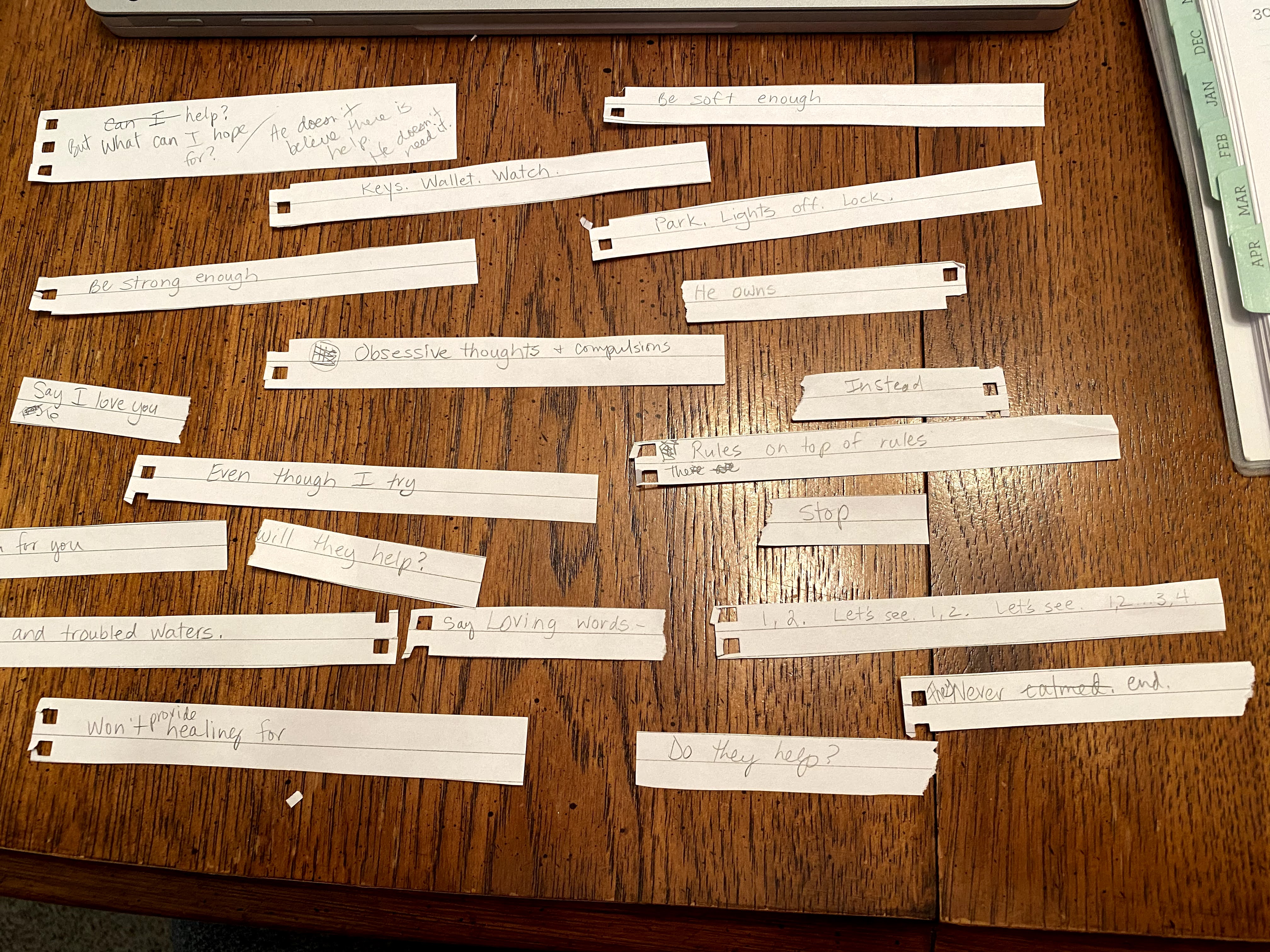
Next, write words, phrases, or sentences on strips of paper (1 line of poetry per strip).
Then, play with the strips. Change the sequence or tear it in half to make two lines. Discard unnecessary language. Add necessary language or revised language.
Finally, decide on the order that becomes the poem you want to write.
Publish.
My poem-draft is too rough to share here, but below is a picture of my workspace. This practice technique took away some of the frustration and fear associated with writing a reverso. Maybe it will help you or your students with their poetry!
The Virginia State Literacy Association Conference 2021, “Illuminating the Path to Literacy.” I found the Zoom link. Click. Author-Illustrator Jarrett Lerner was on the screen. He had a baseball cap on his head backwards. He asked, “Please type ‘Yes’ or ‘No’ in the Chat if you feel you are creative.
Yes! No! Sometimes! Yes, in certain situations, but I cannot draw at all.
Jarrett said it was his goal for all of us to come away with a greater understanding of the creative process and a stronger belief that all human beings have an innate creative energy. He said that our culture has bought into a false notion that drawing is a “You can.” or “You can’t.” ability. When and where did we come to believe that? I remember my first doubt about my drawing happened in 2nd Grade. By 8th Grade, the belief “I can’t draw” was entrenched.
Today, Jarrett Lerner taught me that drawing is an act of seeing and doing. He said that what artists and illustrators do is try to simplify and deconstruct the thing they are trying to draw. They look at what is easiest, what shapes, lines, letter formations could represent the object. All attempts are kept. Then the artist takes a look. What needs changing? What could be added? This is revision and every mistake is an opportunity to learn. We can grow our visual vocabulary and try a variety of tools.
He was right. When we use even a little of our creative energy, we are happier. I’m grateful for the moments of happiness learning with Jarrett Lerner today.
Recently, I read Big Magic by Elizabeth Gilbert which contains thoughts about the creative process, writers, writing, and challenges to the creative life. I never finished Eat, Pray, Love, but I really liked Big Magic.
She wrote about the importance of finding our own voices and expressing ourselves. The term “creative outlet” was used often. I got to thinking about creative outlets in my life such as playing the piano, writing, and dabbling I’ve done with painting and other arts over the years. These experiences help me in the moment to feel present and even happy. They do give me an opportunity to share something of myself.
As I thought, I decided that “creative inlets” are just as important to me. Just as inlets of water provide the right set of conditions for certain ecosystems, creative inlets provide the right set of conditions for ideas to grow, for healing to happen, and for beauty to refresh the soul.
I realized that I need to pay more attention to inlets. What am I inviting and allowing to flow inward to nourish my creative ecosystem? The world is sometimes harsh and the news brutal, but nature teaches us about seasons, ebbs and flows, and surprises us over and over with beauty. I think I need more time outside.
Thank you Two Writing Teachers and teacher-writers in this community.
I’m taking a short course with Georgia Heard on poetic forms. Last night we talked about forms of poetry that are created by borrowing words from other writers. Some in the class said they felt like they were cheating by borrowing, but I found it really fun and stimulating. T.S. Eliot said, “Good writers borrow; great writers steal.” I didn’t know that he borrowed heavily from other writers when he wrote “The Wasteland.”
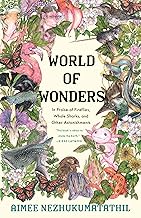
For my practice, I turned to one of my new favorite books, WORLD OF WONDERS, by Aimee Nezhukumatathil. Her writing about natural phenomena is gorgeous. I was sure I would find words to borrow there.
Here is my FOUND POEM after “Firefly” in WORLD OF WONDERS:
Firefly
The first glimmer-pop of firefly light, electric dress, a small flame sputtering erratic flashes of light through the navy blue pause just moments after twilight.
Such a degree of tenderness the quiet reassurance their light rhythm recalibrates sending out their love-light signals a lime glow to the summer night air.