Today in a team meeting, I was surprised by the passion that bubbled up from deep inside me. I talked about intentional teaching of strategies for deeper comprehension. “How are we making choices about what to teach tomorrow?” I heard myself speaking strongly about using quality materials for small group reading. “Kids deserve the best we can afford,” I said. I might have had a critical tone that I didn’t mean. I’m not sure. The struggle I have with being assertive without feeling guilty is raging in my head. Did I overstep? Did I say too much? Or, did I say what needed to be said? Will it make a difference for students?
I know I was reacting. We were having a data discussion and the scores were not good. Suddenly, I was overcome with urgency. I wanted others to share in the effort, to stop blaming the kids, to get off phones and computers and teach. It is urgent. We can’t expect kids to learn if we don’t do the work to teach them. I want success for these kids so much it hurts.
I got home from work late tonight after our Book Fair Family Night. For a complicated set of reasons, we had to move the whole book fair from one room to the cafeteria for the evening event and then back to the original location. About 18 teachers were there to help after school and again at 7:30 p.m. It was fun to work as a team, but after a full day of work, this old grandma is pretty tired.
At 9:30 p.m. I heard my phone ding. A text from my daughter with a picture of her new haircut. Smiles. Then, ding again! This time, a few pictures of Maggie. More smiles.
Ding! This time, pictures of Johnny. He’s nearly a year old and has recently become mobile. I laughed when I saw these. It took me back to 1978 when my firstborn’s favorite pastime was climbing into whatever he could and unloading bookshelves. Over and over he would pull everything out. I would put it all back.
Johnny has been a nearly perfect baby. He eats well, sleeps well, and is generally all smiles. And he’s so squishy. Maybe it’s time for a little mischief with all that sweetness.
I don’t know who taught Emma Zina,
but I do know know she taught Rhea Jeanette
and her granddaughter, Frances,
who taught Linda, Evelyn, and me.
First, we learned to cross-stitch.
Then to embroider with strict attention
to the neatness of the back as well as the evenness
of our backstitches, outline stitches, lazy daisies, and French knots.
Next, we learned to knit
Summers spent looking at patterns
Practicing the cast on, knit, purl, yarnover, cable, and bind off.
We felt the pleasure of discerning a yarn’s weight, heft, and drape.
Crochet was not Mama’s favorite of the needlecrafts,
but we still learned how, just so we could do it if we wanted to.
Emma Zina crocheted lace tablecloths and bedspreads.
Pillowcases and kitchen towels had decorative crocheted edges.
There’s a certain itch to have a needle in hand
from more than 100 years of needlecrafting women.
Joy just in the making.
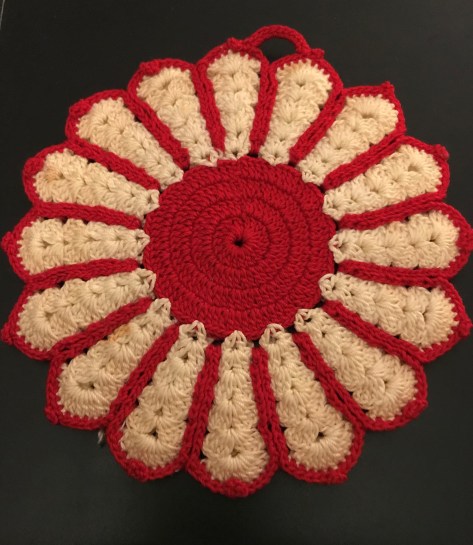
Crocheted Trivet by Emma Zina Player Gawan, (1873-1943)
There was a time when my friend was so angry at the world she turned away a woman who came to her door offering a plate of homemade cookies.
“I don’t want your damn cookies,” she said and shut the door.
On one level it was true. Cookies weren’t going to solve any of the problems she faced.
We don’t usually get to choose how others try to help us. People do what they can in the ways they know.
I realize how often I might hold back giving because of this sad experience. I worry that my cookies aren’t the right response to another’s pain. I need to get over that! I’m thinking I’ll try taking cookies to someone again. The important thing is that my hands reach to another’s.
Do you love World of Dance (WOD)? I do. Right now, I’m a little distracted because it’s a show I enjoy; this is a very full week; I haven’t quite prepared for tomorrow; AND I haven’t yet written. So, I confess I’m writing and watching and thinking about the Learning Circle I’m supposed to facilitate tomorrow. Our Learning Circle is studying growth mindset. Tomorrow our discussion is going to center on five stances described by Kristi Mraz and Christine Hertz in their book, A Mindset for Learning.
We often talk about lenses affecting the way we see things and how they influence how we see our students and their learning. The stances invite us to approach life and learning from different spaces. At least that is how I’m interpreting it. The five stances are optimism, flexibility, persistence, resilience, and empathy. We hear these words often in current media of all types. I hope they don’t just become “buzz” words that lose their power by overuse.
I’m thinking how the performers on World of Dance are mostly young people who certainly exhibit many of these stances (especially flexibility:). I think of all the practice, the dreams, the sacrifice of time and money, all to pursue something beautiful and creative with the body as the instrument. What has allowed these young people to be able to have the goal of performing on World of Dance? When you hear their individual stories, they are varied. Some come from poverty, so it’s not just about opportunity. Some have lost parents or siblings, so it’s not just about family support. What systems of thinking were awakened in them? How? When?
Lenses, stances, and the work. Maybe the dancers’ success is more about the work. In the book, “the work” includes self-talk, storytelling, goal-setting, and reflection. These are the parts to practice. Do I know what self-talk sounds like? What stories are being told with and without words? Is there a goal with a plan? Is there time to rest and reflect?
I have a lot more questions than answers. In the meantime, I’ll enjoy the energy of young dancers, the beauty of an art form I always longed to do, and the ways that dance expresses so much that is universal.
Tonight I was aurally transported. I attended a choral concert of Gabriel Faure’s Requiem in Falls Church, Virginia, and instantly, my mind went to Salzburg, Austria in the spring of 1974. Hearing this elegant, ethereal, even transluscent, piece of music brought back many memories.
I was a young college student spending six months studying abroad in Salzburg with a group of 55 students. Our dormitory was an old hotel that had been rented by the university in Elsbethen, a small town about an hour from the city. Our meals were prepared for us in the hotel. I’d never been a potato eater, but I soon learned that I would starve if I didn’t potatoes. I ended up gaining 20 pounds. Everything tasted so good. Across the street was a small grocery with a barn next to it. The smells of rural Austria in the spring were pungent and new to me.
Part of our educational experience in Salzburg included an agreement between our university and the Mozarteum, a music conservatory in the city, that we students who wanted to could sing in the Mozarteum choir. Many of us also studied piano, cello, and in my case, harpsichord. (That’s another story.) The choir rehearsed every Tuesday afternoon as I recall.
Our choir director was a graduate student in conducting who was preparing a spring concert as his final project before graduation. He was in his twenties. He had long brown hair, very bad teeth, and smoked during rehearsals. He wore tight blue jeans, white T-shirt, boots, and a leather jacket. He looked, to me, like he belonged on a Harley or in a rock-n-roll band, more than as a classical musician wielding a baton. He sat on a stool with his back hunched as he studied the music score in front of him. His English was better than my German which made me nervous as he spoke German when he was frustrated.
We practiced and practiced over many weeks. I grew to know this music so that I heard it in my mind while I walked the foothills, while I did my homework, while I fell asleep. My religious background did not include learning the Latin words of the traditional Requiem form, but I came to feel the power of the text:
Kyrie Eleison
Offertory
Sanctus
Agnus Dei
Pie Jesu
Libera Me, Domine
In Paradisum
I stood next to my friend, Anne, on the night of the performance. I remember looking out at a large audience of strangers in this very old, but grand, concert hall. Then our conductor came out on stage, transformed (as men always are) in a tuxedo. Everything came together that night into an evening of transcendence for me as a young musician. I experienced something I had never known before and can’t really describe, but I know it as something that satisfies me deeply on a level that is unequaled. Sound, energy, heart, vibration, community, unity. It’s the most alive experience to participate in a musical ensemble. It was sheer beauty. Maybe for me, that performance was like a first successful marathon, or a first view of Grand Canyon, or being at the feet of Jesus.
I returned there tonight.
The Mozarteum, Salzburg, Austria
(wikipedia photo)
Here’s a link to In Paradisum, sung by The Cambridge Singers:
I always have several books going at once so that I have choices when I climb into bed at night. I love all things reading, so it might be fiction, nonfiction, memoir, essay, poetry, or professional reading about reading, writing, dyslexia, or engagement. I might read journals, even my own journals. I’m not yet choosing graphic novels for myself, and I don’t often choose fantasy, but I don’t fully exclude them either.
When I was sick earlier this week, I started reading The Great Alone by Kristin Hannah. I loved another book by her, The Nightingale, so I was looking forward to more. I’m about halfway through the book (I’m not a very fast reader). Typically, as a reader, if I own the book, I fold down the corners of pages that have passages which hit me powerfully. There’s a special satisfaction for readers, especially readers who write (I think), when a passage is crafted in a way that you suddenly realize you are holding your breath, or you wish with all your soul that you had penned those words. Or, when you realize you have just read truth.
Such was the case when I read these words of 16-year old, Leni, on p. 117:
She saw how death impacted people, saw the glazed look in their eyes, the way they shook their heads, the way their sentences broke in half as if they couldn’t decide if silence or words would release them from sorrow.
Wow, just wow. I don’t know about you, but in my view, Ms. Hannah nailed it.
It was nearly the end of a very busy day catching up after being out of school for two days. My last little group of first graders was reading Chicken Little. They nailed their reading with expression, and I was really pleased with progress we are beginning to see. When each of them had finished, I was ready to transition to some writing work, but was stopped by Praise.
Praise: Wait! I have a question. How did Chicken Little even know where the king lived?
Me: That’s a really interesting question.
Miles: Maybe she had been to the king’s castle to visit. OR, maybe she was friends with the princess!
Me: That sounds like a story you could write!
I’m still smiling. I never get tired of observing the workings of the minds of first graders.
After a difficult night of GI distress, I woke up and wished I had some Jello. Jello made by my mom. I’m a grandmother and still wish I had my mom, especially when I’m sick. Lacking the energy to get up to make Jello, I stayed in bed and read The Great Alone by Kristin Hannah. Reading in the morning is the only good part of being sick.
Later, I shuffled out to the kitchen in my grape-purple fleece robe and slippers and scrounged around in the cupboards. Jello! I opened the box and poured the sugar mix in a pretty bowl. It took a few minutes for water the to boil. I waited and stared out the kitchen window.
When I poured the boiling water into the bowl, the warm orangeness took me immediately to my mother’s side in the kitchen at 1634 Cecile Street. I saw again her beautiful hands stirring gently, the spoon making tiny circles in the hot liquid. She was always careful to be sure all the gelatin dissolved. I felt again the softness of her arms and could smell her freshly powdered skin. I was probably in the way, but she never said so. She just quietly went about her work.
I think my mother believed Jello worked magic. Whenever we were sick, she let us pick the color and she would make us our own bowl of plain Jello. Coming from the West, she knew hundreds of ways to “dress up” Jello, most of which I didn’t like. I was a picky eater then.
Green Jello with canned pears. Orange Jello with mandarin oranges and bananas. Orange Jello with grated carrots and pineapple. Red Jello with canned frozen raspberries. Grape Jello, lemon Jello and blackberry Jello, on occasion. For Thanksgiving, red Jello with cranberry sauce, celery, pecans, and crushed pineapple. Thankfully, she wasn’t too much into making the Jello with cream cheese or Jello with cottage cheese, but she did enjoy it when other people did. For a while, it was popular to add Coke, Sprite, or Pepsi to your Jello. That made it really special. Once I was even offered green Jello made into a mold with chicken salad ingredients – chicken, celery, eggs, even mayonnaise. Not my favorite.
By now, my bowl of plain orange Jello will be set and when I scoop it out of the bowl and it makes that slurping/sucking sound that only scooped Jello can make, I’ll smile and remember my mom. I’ll eat it slowly and let it dissolve in my mouth, knowing I’ll feel better soon.